
Subject Access Requests: Why governance, people and technology must work together

By Jonny Wathen | TransforMATive

The latest Tes article by Cerys Turner highlights a growing challenge for multi-academy trusts: the increasing volume, complexity and cost of responding to Subject Access Requests (SARs).

The figures are significant. Outwood Grange Academies Trust reports spending approximately £100,000 a year managing requests, while Wellspring Academy Trust describes how a single SAR can involve up to ten members of staff.

These demands place considerable pressure on already stretched education resources.

Importantly, trusts such as Wellspring have invested over several years in developing dedicated information governance capacity, organisational expertise, training and technology. Their experience demonstrates that even trusts with established arrangements are facing increasing pressures.

Others are at different stages of this journey, often managing complex information governance responsibilities alongside competing operational priorities.

For me, the response requires more than additional capacity. It demands a wider conversation about the maturity of information governance across the sector, the effectiveness of existing processes, the role technology can play and the support trusts should reasonably expect from government and regulators.

The challenge is not whether individuals should have access to their personal information. That right is fundamental. The question is how we deliver it effectively, proportionately and sustainably.
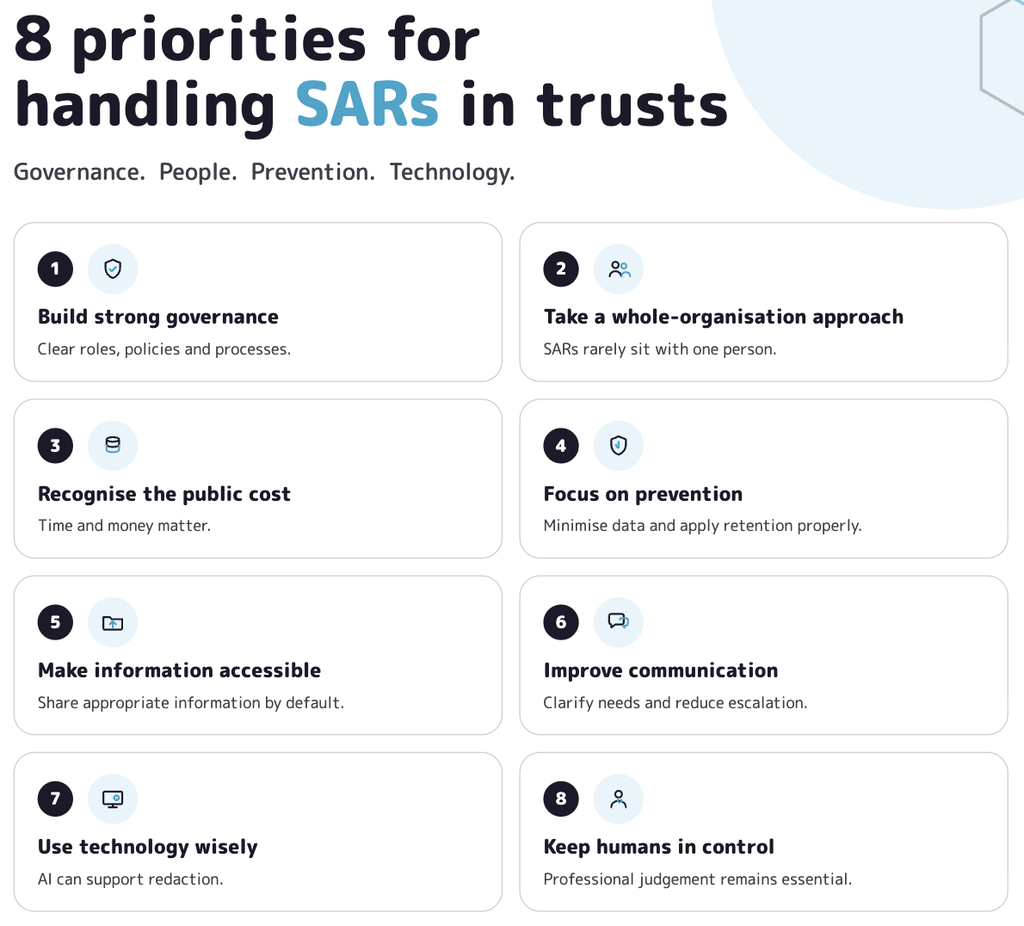
1. Effective information governance is built over time

Information governance is sometimes viewed primarily as a compliance function, with responsibilities delegated to a Data Protection Officer or another designated colleague.

In reality, effective information governance requires much more than an individual with specialist knowledge.

It depends on clear accountability, effective policies, established processes, appropriate systems and an organisational culture in which people understand their responsibilities.

Trusts with mature information governance arrangements have typically invested considerable time and resources in establishing these foundations. Other organisations may still be developing the capacity, skills and systems required to achieve the same level of consistency.

Neither position removes the increasing demands associated with SARs, but organisational maturity can make a significant difference to how effectively those demands are managed.

A mature information governance function does more than respond to requests. It equips the organisation to manage information consistently, proportionately and effectively.

One important observation from the Tes article is that some schools may be undertaking considerably more work than the law requires.

This is a wider sector concern, rather than a judgement on any individual trust. It highlights the importance of understanding both the obligations imposed by legislation and the practical boundaries of those obligations.

Knowing what an organisation is required to do and what it is not required to do, is an essential part of effective governance.

2. Responding to SARs requires a whole-organisation approach

A complex SAR rarely sits neatly within one department or professional discipline.

Information may be held across safeguarding systems, management information systems, HR records, emails, shared drives, pastoral records and other platforms.

Responding appropriately can, therefore, require coordinated input from school leaders, safeguarding professionals, HR teams, IT colleagues, administrators and information governance specialists.

Even the most experienced Data Protection Officer cannot manage this effectively in isolation.

Staff need appropriate training to understand how to identify relevant information, recognise sensitive personal data, preserve records, undertake proportionate searches and escalate decisions requiring specialist judgement.

There must also be clarity about who coordinates the response, who undertakes searches, who reviews information and who ultimately authorises disclosure.

The capability of the organisation is just as important as the expertise of the individual responsible for compliance.

This is why investment in training, shared understanding and established workflows should be viewed as essential organisational development rather than simply an additional compliance cost.

3. The public cost requires a coordinated response

Perhaps one of the most important considerations is the financial impact of responding to increasing volumes of SARs.

When an academy trust spends tens or even hundreds of thousands of pounds managing requests, that represents public money and staff capacity that cannot simultaneously be directed towards teaching, pastoral support or wider educational provision.

Of course, meeting statutory information rights is itself a legitimate and necessary use of public resources. The concern is the extent to which inefficient processes, uncertainty and avoidable administrative work increase that cost.

I would encourage both the Department for Education (DfE) and the Information Commissioner’s Office (ICO) to consider these wider implications when developing guidance, policy and expectations for the sector.

The ICO already provides guidance on reasonable and proportionate searches, clarification and the circumstances in which requests may be considered excessive or manifestly unfounded.

However, the experiences highlighted by Tes suggest that translating this guidance into consistent operational practice remains challenging.

School trusts need practical, education-specific examples addressing the complexity of SEND and safeguarding records, multiple information systems, large volumes of correspondence, third-party information and requests that span several years.

There is also a need for greater clarity about how organisations should respond to repeated requests and the specific circumstances in which the legal thresholds for refusal may be met.

The right of access must be protected, but trusts should not be left to interpret complex operational questions independently, potentially duplicating effort and incurring unnecessary cost.

Clearer guidance, practical resources and greater consistency could make a meaningful difference to the public cost of compliance.

4. Prevention should be part of the strategy

Much of the current conversation focuses on how schools can respond to SARs more efficiently.

That is important, but I think we should also consider how better information management could reduce the amount of unnecessary work involved before a request is ever received.

Data minimisation and effective retention practices are particularly relevant.

Most trusts have published retention schedules, but how consistently are these being implemented across every school, department and information system?

Are records being appropriately reviewed and deleted in accordance with established policies and legal requirements? Is unnecessary legacy information accumulating in shared drives, email accounts and disconnected systems?

The more information an organisation retains unnecessarily, the greater the potential burden when it must identify, search and review records. There is also a direct correlation with the growing cyber threats also experienced across the sector and beyond.

Importantly, this is about proactive, lawful information management, not deleting information in response to an existing request or circumventing disclosure obligations.

EdTech suppliers also have an important responsibility here.

Schools should not have to rely on manual workarounds to implement basic retention and deletion policies. MIS providers and other technology vendors should make it easier for trusts to apply retention schedules, manage access permissions and maintain appropriate information throughout its lifecycle.

Some suppliers have already begun improving these capabilities, but I would argue that effective information lifecycle management should increasingly become an expected feature of education technology.

5. Make appropriate information available by default

Another opportunity is to consider whether individuals need to make formal requests to obtain information that could reasonably be made available through existing channels.

Parents, carers and learners increasingly interact with schools through secure portals, apps and other digital platforms.

Could some of the information routinely requested through SARs be made available more easily through these systems?

For example, appropriate learner records, contact information and other routinely accessible information could be presented through secure platforms, subject to relevant legal rights, safeguarding considerations and access permissions.

Regular opportunities to review and correct information could also improve data quality and reduce misunderstandings.

This is not a substitute for the statutory right of access, nor should it create barriers to exercising that right.

However, making appropriate information readily available can reduce avoidable administration while improving transparency and strengthening relationships with families.

It is a relatively simple example of how better information management and purposeful digital design can benefit both the organisation and the individuals it serves.

6. Relationships, communication and clarification matter

We should also acknowledge that SARs are sometimes submitted alongside complaints, disputes or concerns about an individual’s experience of a school.

In these circumstances, the underlying issue may extend beyond the information being requested.

This makes the quality of communication and relationships particularly important.

Clear explanations, accessible information and constructive engagement can sometimes prevent misunderstandings from escalating.

The growing use of generative AI adds another dimension.

AI tools make it considerably easier to produce lengthy, detailed requests containing extensive references to legislation and broad demands for information.

That does not make a request invalid or imply that the individual has acted unreasonably. However, it can sometimes create a gap between the wording of a request and the information the person is actually seeking.

Where clarification is reasonably required, a constructive conversation may help identify the information sought and enable a more focused, effective response.

Such conversations must never be used to discourage legitimate requests or impose unnecessary barriers. They should be conducted within the applicable legal requirements and with respect for the individual’s rights.

There is a wider lesson here.

Good information governance is not solely about policies and processes. It is also about communication, transparency, trust and professional judgement.

7. Technology should reduce the burden without replacing professional judgement

Technology has an increasingly important role in supporting information governance, particularly where processes involve large volumes of repetitive administrative work.

Redaction is a clear example.

Anyone who has been involved in responding to a complex SAR will recognise the considerable time required to review documents, identify personal information, protect third-party identities and prepare records for disclosure.

These tasks are necessary, but elements of the work can be extremely resource-intensive when undertaken manually.

This is precisely the type of challenge we have been exploring at TransforMATive.

Our Eclipse platform has been designed specifically for education to support organisations with AI-assisted redaction.
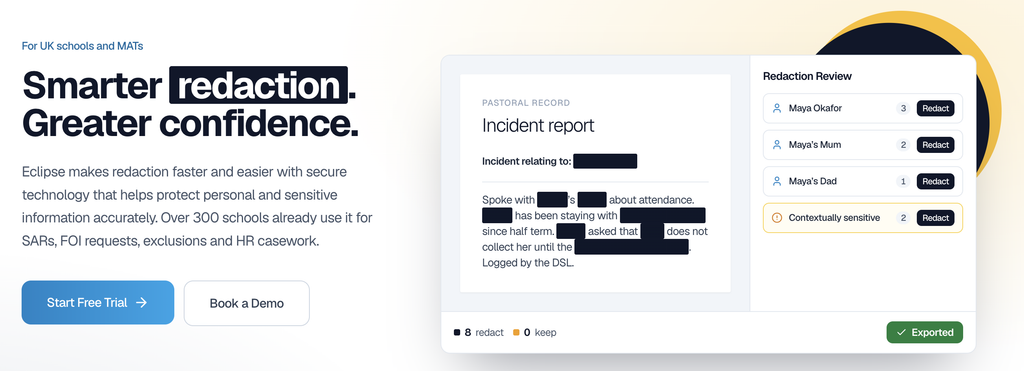
Using machine learning and AI, Eclipse helps identify personal and potentially sensitive information, including contextual relationships that may require further review, allowing staff to complete redaction workflows more efficiently.

Importantly, Eclipse retains the human in the loop.

The technology supports the identification and redaction process, while authorised professionals retain responsibility for reviewing the information and deciding what should be disclosed, what should be protected and whether the final output is appropriate.

This distinction is essential when processing safeguarding information, sensitive educational records and personal information relating to children and families.

Eclipse is now used by more than 300 schools across England, reflecting growing interest in practical technologies that can reduce administrative workload while retaining appropriate professional oversight.

However, technology should not be viewed as a substitute for good governance, clear processes or trained colleagues.

The objective is to automate appropriate tasks, not automate accountability.

8. A sustainable response requires collective action

The increasing volume and complexity of SARs is not a challenge that individual schools and trusts should be expected to address entirely in isolation.

There are responsibilities across the education system.

  • Trust leaders and governing boards should ensure that information governance arrangements are appropriately resourced, proportionate and regularly reviewed.
  • Information governance professionals should be supported through training, consistent processes and access to specialist advice.
  • The DfE and ICO should work together to provide clearer education-specific guidance and practical resources, recognising the operational and financial implications for schools.
  • EdTech suppliers should help organisations manage information throughout its lifecycle, including access, retention, deletion and appropriate automation.
  • The wider sector should share emerging practice, lessons learned and opportunities for greater consistency, rather than every trust independently developing solutions to the same problems.

For me, the strongest approach brings together governance, prevention, people, practice and technology.

Each has an important role, but none is sufficient in isolation.

A practical next step for trusts

For trusts currently experiencing increasing demand, I would encourage a review of the complete SAR process rather than simply adding more capacity to existing arrangements.

Some useful questions to consider include:

  • Where are the greatest bottlenecks and administrative pressures?
  • Do colleagues across the organisation understand their responsibilities?
  • Are searches and reviews being conducted proportionately?
  • Are published retention schedules being implemented in practice?
  • Could appropriate information be made available more routinely?
  • Are there opportunities to improve communication and clarification?
  • Which repetitive activities could be supported more effectively through technology?
  • Where would clearer guidance or specialist support make the greatest difference?

For those exploring AI-assisted redaction, Eclipse is available to trial free of charge, providing an opportunity to evaluate how technology could support existing information governance processes without making an immediate investment.

Explore Eclipse and start a free trial →

Ultimately, the objective should not be to make it more difficult for individuals to exercise their information rights, nor should it be to remove people from important decisions.

It should be to establish better processes, reduce unnecessary administrative work, protect sensitive information and ensure that valuable education resources are used as effectively as possible.

The increasing demand for SARs should prompt an important conversation about the expectations we place on schools, the resources available to meet those expectations and the opportunities to work more intelligently across the sector.

Good governance provides the foundations. Prevention reduces avoidable demand. Skilled people make the decisions. Technology helps make the process sustainable.

And as demand continues to grow, bringing these elements together has never been more important.

These same principles of accountability, purposeful innovation and human oversight are also central to Governing AI in school trusts, the guidance I recently co-authored with Samira Sadeghi for the Confederation of School Trusts (CST), in association with TransforMATive, which explores how trust leaders can govern AI responsibly while ensuring technology serves educational purpose and public benefit.


Belonging and Attainment: What DfE Research Reveals

A pupil who doesn’t feel they belong at school is, on average, doing worse. Not slightly worse, but close to a full GCSE grade worse across their entire set of results.  That’s the headline from research commissioned by the Department for Education. For trust leaders, it provides some of the clearest evidence yet that wellbeing and academic attainment are not separate agendas competing for the same time, resource, and budget. They are fundamentally connected.

A central focus of the TransforMATive Digital Leadership Summit is how multi-academy trusts move beyond siloed systems and build genuinely connected intelligence. This research challenges executive teams to look closely at their own digital ecosystems. The DfE study analysed survey responses from 4,763 pupils in 165 English schools, linking their answers about school belonging directly to their Key Stage 4 attainment data. In doing so, it connects what pupils say about their lived experience of school with their measured academic outcomes demonstrating why digital and data strategies must do the same.

A GCSE grade’s worth of difference

The research measured pupils’ sense of belonging against their Attainment 8 scores, the metric that averages a pupil’s results across eight GCSE subjects. After accounting for prior attainment, pupil characteristics and bullying, pupils who strongly disagreed that they belonged at school scored 7.72 points lower on average than those who strongly agreed, a gap equivalent to almost a full GCSE grade across all eight subjects. Pupils who simply disagreed, without feeling strongly about it, scored 4.02 points lower. The DfE is careful to note that this shows an association rather than proven cause and effect, but the scale of the gap is hard to ignore.

Which pupils report lower levels of school belonging?

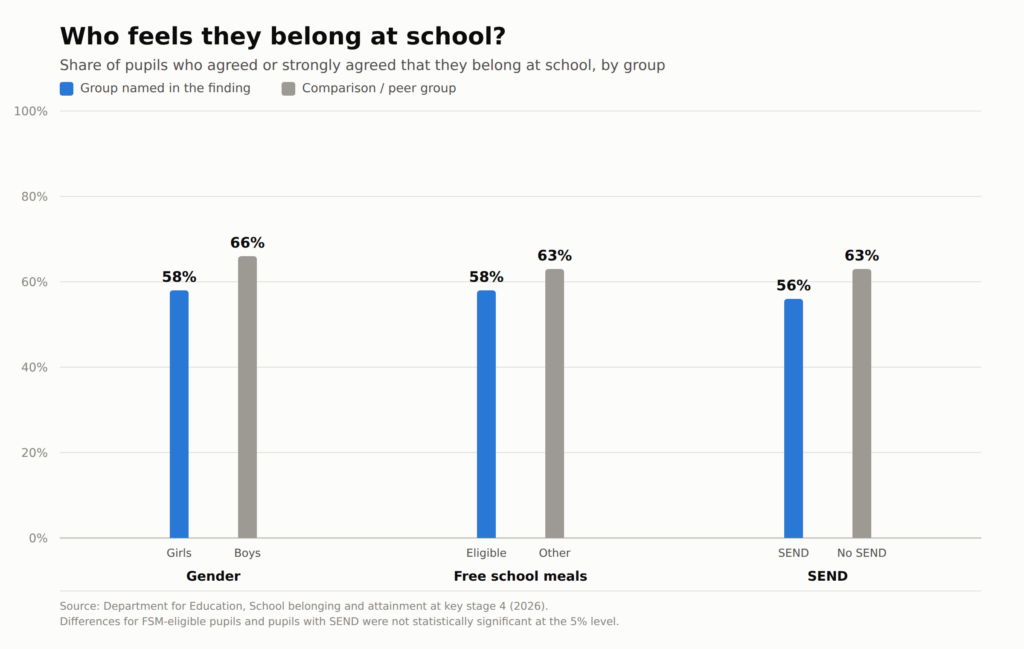
The same research found clear disparities in reported belonging. Girls, pupils eligible for free school meals (FSM) and pupils with SEND were less likely to say they felt they belonged at school than their peers, although the differences for FSM and SEND were not statistically significant at the 5% level.

  • 58% of girls felt they belonged at school, against 66% of boys
  • 58% of pupils eligible for free school meals felt they belonged, against 63% of other pupils
  • 56% of pupils with SEND felt they belonged, against 63% of pupils without

These are exactly the groups schools already spend the most pastoral effort trying to support. In light of these findings, having a reliable way to measure belonging, rather than infer it, more useful than ever.

The government’s approach to measuring school belonging

The findings add weight to a direction of travel already set out in the DfE’s Every Child Achieving and Thriving white paper, which sets out an explicit ambition: every school monitoring pupils’ sense of belonging and engagement by 2029, through a planned pupil engagement framework, up from around 60% of schools doing so today. That ambition isn’t sitting on a shelf: in April, the first major piece of wellbeing-focused legislation – The Children’s Wellbeing and Schools Act 2026 – received royal assent. While the Act doesn’t put wellbeing monitoring on a statutory footing itself (that’s still due through the separate pupil engagement framework), it shows a government moving from writing ambitions down to legislating for them. This legislation follows the same logic already built into Ofsted’s current framework, which grades schools on ‘personal development & wellbeing’ as a standalone judgement area.

Put together, the direction of travel is clear. Wellbeing monitoring is moving from good practice to expectation. School leaders can be getting ahead of expectation and embedding best-practice before it’s required by ensuring they have a reliable way to track wellbeing today.

What it means for FE and training providers

Attainment 8 is a schools-only measure, so this particular study doesn’t speak directly to post-16 outcomes. However, there is a parallel shift in post-16 inspection towards making learner wellbeing, belonging and participation more explicit. Under Ofsted’s renewed framework, ‘participation and development’ is a graded evaluation area, and inspectors consider whether learners belong, feel valued and are supported to thrive.

Separate research from the Association of Colleges found that 88% of responding colleges identified poor mental health as one of the top three reasons for poor student attendance in 2023/24, up from 50% before the pandemic. The 2024/25 survey paints a starker picture still: 90% of colleges reported an increase in 16-18 year-olds disclosing mental health issues, and 74% reported an increase in suicide ideation in the same age group over the previous year. The AoC have laid out a Mental Health Charter, which sets out standards colleges can work towards.

These data points confirm that the underlying question – “do you actually know how your learners are doing, beyond attendance and grades?” – is the key question to be asking.

You already have a way to measure this

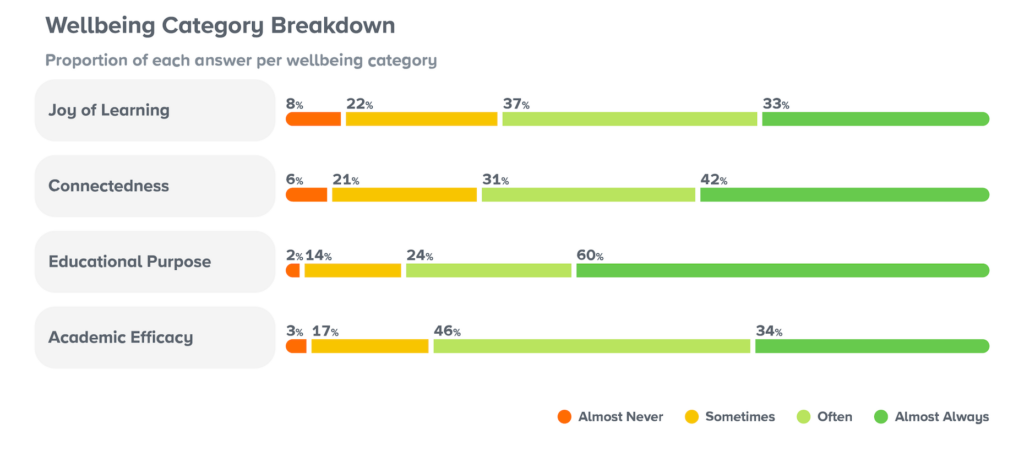
This is precisely the question the CENTURY Wellbeing Tool was built to answer, and it’s included in every CENTURY subscription at no extra cost. Built on the validated Student Subjective Wellbeing Questionnaire, it takes a learner under five minutes to complete and reports back across five domains: connectedness, academic efficacy, joy of learning, educational purpose and safety. Reporting is immediate and confidential, with safety flags for anyone who may need immediate support.

You can run the questionnaire as often as you like: our recommendation is to do a termly check in with the tool to get a picture of belonging alongside the academic data you already track on CENTURY. We covered how the tool works in more detail in our article Supporting Every Learner.

Government policy is inevitably heading towards a world where every school and college can answer, with evidence, whether their pupils and learners feel they belong. However, what a school or trust does with a term’s worth of data is the part that actually moves the dial, and it is a question worth returning to on its own.

For now, the practical starting point is ensuring you are capturing that data seamlessly. CENTURY customers already have the Wellbeing Tool to do this built directly into their platform at no extra cost, allowing them to view a picture of belonging alongside the academic data they already track.

The answer to better trust-wide insight is not always more technology; sometimes, it is making what we already have work better together.   

Connected Intelligence with TransforMATive & CENTURY Tech

This challenge of linking strategic ambition with practical, trust-wide delivery lies at the core of CENTURY Tech’s involvement in the TransforMATive Digital Leadership Summit at the University of Leeds. 

Through CENTURY’s “Connected by Design?” digital leadership health check framework, trust leaders can systematically evaluate how strategy, people, systems, and data work together to drive meaningful impact across their schools.

Connect: Creating the Space to Think

As part of the preparation for TransforMATive LIVE: Sweden, our leadership exchange taking place in December, I recently had the opportunity to spend a few hours in Stockholm.

Sweden feels like a particularly relevant place for this conversation. It has a long history of digitalisation in education, strong digital infrastructure and skills, and a well-developed EdTech ecosystem. Around nine in ten secondary pupils have access to a school-provided digital device, while the European Commission continues to describe Sweden as having a strong digital ecosystem, high-quality connectivity and a highly digitally skilled population. Digital Strategy

For me, that makes Sweden interesting not simply because technology is present, but because it provides an opportunity to explore what happens after digital adoption. How do digitally mature organisations make better choices about what technology should enable, where it should sit and, increasingly, where it should not?

That question stayed with me as I experienced Stockholm.

From the Vasa Museum and Djurgården, across the waterfront and Skeppsholmen, through to the Royal Palace and the streets of Gamla Stan, what struck me was the contrast.

The Vasa itself provides an extraordinary leadership lesson. It was an ambitious seventeenth-century Swedish warship which sank in Stockholm harbour just minutes into its maiden voyage in 1628, before being recovered from the seabed 333 years later. Vasa Museum

For me, its story is a reminder that progress is not simply about ambition, resources or technical capability.

It is also about judgement.

Challenge.

And whether an organisation creates the conditions for good decisions to be made.

Elsewhere, Stockholm brings together history, culture, design and modern public life in a way that feels intentional and connected rather than hurried.

That feels increasingly relevant to leadership in the age of AI.

AI gives us the ability to move faster, process more information and automate increasing amounts of work.

But speed and productivity are not the same thing as progress.

If every efficiency simply creates capacity for another report, another task, another analysis or another decision, we risk replacing workload with work intensity.

For MAT leaders, that distinction matters.

The promise of digital transformation should not simply be that we can fit more into the working day.

It should be that we can make better decisions about what deserves our time in the first place.

That is why I increasingly think head space is becoming a strategic resource.

Leaders need space to think.

Space to challenge assumptions.

Space to make connections between things that might otherwise remain separate.

Space to listen to different perspectives.

And, occasionally, space to decide that something does not need to be done at all.

This thinking sits at the heart of the Connect theme for our Digital Leadership Summit and our wider TransforMATive community, including TransforMATive LIVE.

Connect is not simply about bringing people together.

It is about creating the conditions for reflection, challenge and shared understanding.

It is about stepping outside the rhythm of everyday operational leadership long enough to ask whether we are solving the right problems, whether technology is genuinely helping and whether activity remains connected to organisational purpose.

These moments deliberately introduce a little useful friction.

They allow us to listen.

To compare experiences.

To question what has become normal.

To understand how other organisations are approaching similar challenges.

And to consider where technology can genuinely add value, rather than simply add pace.

For me, that leaves three increasingly important questions for MAT leaders:

What can technology enable us to do?

But also:

What should we do differently because the technology now exists?

And perhaps most importantly:

What should remain fundamentally human?

As trusts mature digitally, those questions become more important, not less.

The greatest value technology creates may not always be additional capacity to do more.

Sometimes it is the space to think more clearly about what matters, what we can stop doing and what should come next.

Perhaps that is one of the most important forms of Connect of all.

Jonny Wathen
CEO, TransforMATive

TransforMATive Insights brings together learning from our work with multi-academy trusts, sector leaders and partners, informed by the latest research and emerging evidence, to explore the issues, opportunities and practical choices shaping digital leadership across education.

Relational Architecture: Design the Spaces Between the Boxes

Most conversations about operating models begin with structure.

Who reports to whom? What sits centrally? What remains within schools? Where does responsibility ultimately sit?

Those questions matter. But increasingly, I think some of the more important organisational challenges sit between the boxes.

Take AI governance.

A trust can appoint a senior responsible officer, publish an AI policy and establish a clear approval process.

Structurally, everything can look sensible.

But what happens when a teacher identifies a new use case?

When should the DPO become involved?

When does curriculum leadership need to engage?

Who speaks to procurement?

How does learning from one school reach another?

And what happens when an issue crosses technology, safeguarding, education, data protection and finance at the same time?

The answer rarely sits neatly within a single role or reporting line.

That is relational architecture.

It is the way people, teams and responsibilities connect around the work that actually needs to happen.

This feels particularly relevant to our Connect theme for this year’s Digital Leadership Summit.

As trusts grow and become more digitally mature, the challenge is not simply to design clearer structures. It is to ensure that the relationships between those structures are equally deliberate.

Evidence around organisational decision making consistently suggests that allocating roles and responsibilities is only part of the answer. Effective organisations also need clarity about how those roles interact, where information moves, who needs to be involved and how disagreement is resolved.

The same is true of organisational networks. Performance is shaped not only by formal hierarchy, but by the connections that allow knowledge, challenge and expertise to move across traditional boundaries.

For MAT leaders, that creates another set of questions.

Who needs to connect with whom?

About what?

How frequently?

What information should move between them?

Where does a decision ultimately sit?

And what happens when there is legitimate disagreement?

These questions become even more important in a trust model, where local agency and organisational coherence will always need to coexist.

The ambition should not be to centralise every decision or create another layer of process.

It should be to design the connections that allow the right decisions to be made, by the right people, with the right information.

That is why Connect is not simply about collaboration.

It is about organisational design.

It is about recognising that the quality of a trust’s operating model is shaped as much by the relationships between functions, schools and leaders as it is by the structures themselves.

So the provocation I would offer MAT leaders is simple:

If you removed every box from your organisational chart and left only the connections between them, would there still be an operating model?

If not, we may have designed the organisation, but not yet designed how it actually works.

Jonny Wathen
CEO, TransforMATive

TransforMATive Insights brings together learning from our work with multi-academy trusts, sector leaders and partners, informed by the latest research and emerging evidence, to explore the issues, opportunities and practical choices shaping digital leadership across education.

Social Network Theory: The Organisation You Cannot See on the Structure Chart

We can describe a multi-academy trust very neatly.

There is an executive team. Central functions. Regional structures. Schools. Committees. Reporting lines and accountability.

But that is not necessarily how the organisation actually works.

Knowledge rarely moves only through formal structures. Advice, influence, challenge and problem solving often travel through relationships that sit alongside the organisation chart. Some are visible. Many are not.

That matters.

Research into social networks has consistently shown the importance of connections between people who would otherwise sit in separate groups. It also highlights the value of individuals who bridge gaps between different networks, helping information, knowledge and opportunity move across organisational boundaries.

Applied to a multi-academy trust, the implications are significant.

Two headteachers might occupy exactly the same position on an organisational chart, with the same reporting relationship and broadly similar responsibilities.

But their experience of the organisation can be completely different.

One may speak regularly with five other heads, have strong relationships with colleagues in the central team, know who to contact when something goes wrong and feel confident asking for advice.

Another may primarily interact with their own school and formal line manager.

Structurally, they are identical. Relationally, they are very different.

As trusts grow, I think one of the most valuable leadership exercises is therefore to understand the network that actually exists.

Where does advice really come from?

Who do colleagues contact when they need help rather than when the process tells them to?

Who connects education with technology, finance with operations, or schools with the central team?

Where is important knowledge repeatedly held by one individual?

And which colleagues have quietly become critical points of organisational dependency simply because they are trusted, connected and know how things really work?

This becomes particularly important as trusts mature digitally.

Technology can make communication easier and information more accessible, but it does not automatically create meaningful connection. In fact, more platforms, more channels and more information can just as easily create additional noise.

The objective should not be maximum connectivity.

It should be purposeful connectivity.

For our Digital Leadership Summit, that is what makes Connect much more than an invitation to network.

Connect is an organisational design challenge.

It is about understanding how knowledge, trust and influence move through the trust. It is about ensuring that expertise is not trapped within individual schools, teams or roles. And it is about creating deliberate connections between the people responsible for education, operations, finance, people, data and technology.

Digital maturity increasingly depends upon this.

A trust can have excellent systems and still struggle if the relationships between those systems, teams and decisions are weak. Equally, strong networks can help organisations adapt more quickly, share practice more effectively and make better use of the expertise that already exists within them.

Perhaps the most useful question is this:

If we removed every formal reporting line from the organisation chart and instead mapped where knowledge, trust and influence actually flowed, what would our organisation look like?

And, more importantly, is that the organisation we intended to build?

Jonny Wathen
CEO, TransforMATive

TransforMATive Insights brings together learning from our work with multi-academy trusts, sector leaders and partners, informed by the latest research and emerging evidence, to explore the issues, opportunities and practical choices shaping digital leadership across education.

Connect: What digital leadership now requires

Connect Before You Automate

For several years, one of the promises of digital transformation has been that technology will give us time back.

AI makes that promise feel more achievable than ever. Reports can be drafted in minutes. Information can be synthesised almost instantly. Analysis that once required hours can happen before the next meeting begins.

But for leaders, there is a more important question:

What happens to the time we save?

Across our work with multi-academy trusts, we are increasingly seeing a tension between efficiency and intensity. When technology makes something quicker, the natural response can be to do more of it. Another report. Another scenario. Another analysis. Another meeting.

The risk is that we use technology to accelerate an operating model that was already too busy.

Efficiency can very quickly become intensity.

This matters because digital leadership is not simply about introducing better tools. It is about creating the organisational conditions in which technology genuinely improves the experience of pupils, staff and communities.

If AI reduces the production of a board report from three hours to thirty minutes, do we consciously return some of that capacity to colleagues? Do we create space for professional judgement, relationships and reflection? Or do we simply commission more activity because the capacity now exists?

That is why the theme of this year’s TransforMATive Digital Leadership Summit begins with Connect, before we move to Enable and ultimately Lead.

Connect is about more than technology.

It is about connecting digital investment to organisational purpose. Connecting strategy to the realities of delivery. Connecting leaders across education, operations, finance, people, data and technology. And, increasingly, connecting trusts with one another so that learning, challenge and innovation can be shared across the system.

Before we automate a process, we should ask whether the process still needs to exist.

Before we introduce another platform, we should understand the problem we are trying to solve.

Before we use AI to increase capacity, we should decide deliberately what we want to do with the capacity it creates.

And before we pursue the next technology opportunity, we should be clear about what should remain distinctly human.

For MAT leaders, the opportunity is not simply to make an already busy organisation move faster.

It is to redesign the organisation around what matters.

That requires connection first.

TransforMATive Insights draws upon our ongoing work with multi-academy trusts, sector leaders and partners, alongside the latest research and emerging evidence, to identify the themes, challenges and opportunities shaping digital leadership across education.

The Vehicle Is Not the Driver

Why Seeing Teaching Clearly Is Not the Same as Improving It

Written by Danielle Finlay, October 2026

Abstract

Every conference about the future of education now promises greater visibility: better dashboards, richer data and more connected systems that help leaders see what is happening in classrooms. Written for a conference exploring how leadership, technology and organisational practice can combine to transform education, this article argues that visibility is a beginning, not a destination. Drawing on research into judgement, organisational culture and school improvement, alongside an anonymised leadership experience from a multi-academy trust, it considers how greater visibility can support better decisions, but can also accelerate weak ones when seeing is mistaken for understanding. The central claim is simple: technology is the vehicle. Whether that vehicle moves an organisation towards genuine improvement depends on the culture, judgement and behaviour of the leaders driving it. The article proposes a discipline, Know, Interpret, Act, Learn, through which visibility can become wiser rather than merely faster decision-making.

Introduction: The Question Behind the Conference

I am writing this a few weeks before I stand in front of a room of trust chief executives and system leaders at the TransforMATive Digital Leadership Summit, an event exploring how leadership, technology and organisational practice can combine to transform education. I believe technology can play a powerful part in that transformation, or I would not have spent the last several years of my career engaging with, and more recently leading, a platform designed to support it. But I want to use this piece to challenge one assumption that can sit too easily alongside conversations about educational technology: that greater visibility necessarily leads to better decisions.

Visibility is not the same as improvement. Seeing more of teaching does not automatically mean understanding it better. A sector that is becoming more instrumented, more dashboarded and more data-rich is not thereby becoming more insightful. In some organisations I have worked in and with, the more visible teaching became, the more important it was for leaders to slow down their interpretation, precisely because visibility arrived faster than the judgement required to use it well.

This is not an argument against technology. It is an argument about what technology is for, and what it is not for. Technology is the vehicle. It can connect evidence, expose patterns and move an organisation somewhere. It cannot decide where that organisation should go, or whether what has become visible is sufficient to justify action. Those decisions, and the culture in which they are made, belong to leaders.

That is the argument of this piece: visibility must come before judgement, but visibility is a beginning, not an answer. I will draw on research into decision-making, organisational culture and school improvement, and on my own experience leading through this tension, to make the case for a discipline that converts what technology reveals into something worth calling insight.

The Familiar Shape of the Problem

Ask any group of trust leaders whether they lack information about teaching, and the answer is almost never yes. Most schools and trusts I have worked in are rich in evidence: lesson visits, book looks, pupil voice, CPD logs, appraisal targets, learning walks and coaching records. The problem is rarely a shortage of activity intended to improve teaching. It is more often a problem of connection and interpretation.

Four patterns recur with striking regularity across contexts that otherwise look very different.

The first is disconnection. Lesson visits happen in one system, feedback lives in another, CPD is planned in a third, and appraisal sits in a fourth. Each activity is defensible in isolation. Collectively, they do not always add up to a coherent account of what the organisation understands about its own teaching.

The second is variable interpretation. Leaders can observe the same practice and reach meaningfully different conclusions, not necessarily because any of them is wrong, but because they are applying slightly different, often unarticulated, theories of what great teaching looks like. At trust scale, that variation can become inconsistency that teachers experience as unfairness.

The third is blanket action. A leader notices a pattern, perhaps in one department or from a small number of visits, and the response becomes a whole-school programme. Precision is sacrificed for the appearance of decisiveness, while the people who most need support may receive the same generic response as everyone else.

The fourth is initiative fatigue. Activity accumulates. Frameworks are launched and then quietly superseded. Staff experience change not as progress but as churn, with another priority added before the previous one has been properly evaluated or embedded.

None of these patterns is caused by a lack of commitment. What is often missing is architecture: the connective tissue that allows one piece of evidence to inform the next, one leader’s interpretation to be tested against another’s, and one action to be evaluated before a further response is added (Fullan and Quinn, 2016; Bryk et al., 2015).

This is where the promise of education technology becomes both useful and demanding.

The Visibility Trap

The seductive version of the story goes like this: fragmentation is a data problem, and data problems have technological solutions. Bring every signal into one place, present it clearly enough, and the fog lifts. Leaders will finally see their organisation as it really is.

That promise is only half true.

Daniel Kahneman’s work on judgement offers an uncomfortable starting point. Human beings are highly susceptible to substituting a difficult question for an easier one, particularly under time pressure and when information feels abundant (Kahneman, 2011). When faced with the demanding question:

What does this tell us about practice over time and context?

It is far easier to answer a different one:

What does this snapshot suggest?

Data does not protect leaders from that substitution. It can give an answer a sense of legitimacy that intuition alone does not.

Jerry Muller’s critique of metric fixation sharpens the point. Once an indicator exists, there is a strong institutional pull towards treating it as a proxy for the complex reality it was only ever meant to represent, and then towards managing the proxy rather than the reality (Muller, 2018). A dashboard showing repeated weak drop-ins in a department can very easily become “the department with a problem”, when a slower, triangulated account might tell a more complicated story.

This is the visibility trap: seeing more can feel like understanding more, when it may simply move leaders faster, and with greater apparent authority, towards conclusions the evidence does not yet support. The clearer the picture becomes, the more disciplined leaders must be about what it allows them to say reliably.

Let me tell you how that lesson can play out in practice.

The Trust That Saw Too Much, Too Soon

A few years ago, while working across a multi-academy trust, I reviewed typicality data drawn from lesson visits across a number of schools. Something in the pattern did not sit right. Some schools with a history of weaker outcomes were showing a noticeably higher proportion of teachers evaluated as meeting the expected standard than schools with a longer record of stronger performance.

Read quickly, that looks like good news. Read against other evidence, including pupil outcomes, external validation and the longer-term trajectory of those schools, it raised a different question.

The temptation was to take the data at face value. Instead, we treated the pattern as a prompt for enquiry rather than an answer:

What does “expected standard” actually mean, in practice, across these schools?

How consistently are our leaders applying and moderating it?

Are different local contexts shaping how reassurance and accuracy are being balanced?

We commissioned a cross-school calibration process rather than a review of individual staff: joint learning walks, moderated discussion of evidence gathered through our platform, and structured professional dialogue between leaders working in contrasting contexts. What we found was not that teaching in some of our historically weaker schools had quietly become stronger than teaching in our strongest ones. It was that leaders emerging from a period of sustained difficulty had, understandably and with good intentions, adopted a more generous interpretation of what “expected” meant while trying to rebuild confidence.

This was not a failure of professionalism. It was a cultural signal about how reassurance and accuracy were being balanced under pressure, and it would have been difficult to see without the data. It would also have been easy to misread through the data alone. Had we treated the pattern as a verdict rather than a prompt for enquiry, we would have drawn the wrong conclusion at precisely the moment our confidence in the platform’s visibility was highest.

The correction was not to distrust the technology. It was to recalibrate what “expected” and “excellent” meant in practice, using shared exemplars and moderated professional dialogue, and to make clear that accuracy was not a punishment. Only when diagnosis is honest can support be targeted where it is genuinely needed (Kahneman, 2011; Wiliam, 2011).

Just as importantly, the way we approached that recalibration mattered. Leaders went into those schools to understand how the judgement had been formed, not simply to correct it. We acknowledged the context those schools had travelled through and treated the centre as a partner asking a hard question alongside them, rather than an inspectorate arriving with a verdict. That protected the trust required for the recalibration to become useful rather than defensive (Bryk and Schneider, 2002).

I share this story because it is the clearest illustration I have of the difference between visibility and understanding. The platform did exactly what it was designed to do: it made a pattern visible that might otherwise have remained hidden inside separate sets of local judgement. What it could not do was tell us what that pattern meant. That interpretation depended on leaders willing to be curious rather than reassured, and on a culture in which an uncomfortable question about our own data could be experienced as rigour rather than disloyalty.

The Vehicle and the Driver

This is where I want to return to the framing behind this piece.

Technology is the vehicle. It is genuinely capable of moving an organisation somewhere: connecting evidence that would otherwise stay scattered across notebooks, inboxes and individual memory; making patterns visible at a scale no single leader could hold in their head; and preserving a professional conversation so it does not have to be reconstructed every time a new leader joins the organisation. All of that is real, and none of it is trivial.

But a vehicle does not choose its destination, and it does not know when it has arrived somewhere true rather than somewhere merely visible. Nor does it take account of who is travelling and how they experience the journey. That is the work of leadership behaviour and the culture it creates.

Edgar Schein’s distinction between climate and culture is useful here (Schein, 2010). A new platform, however sophisticated, interacts first with the current climate around feedback, scrutiny and change. Only when leadership behaviour around that platform is consistent, visible and trusted over time does technology become part of a healthier organisational culture (Bryk and Schneider, 2002).

This is why the same technology can produce very different experiences in different organisations. Where leaders invite challenge to their own interpretation of the data and treat patterns as prompts for professional dialogue, visibility is more likely to be experienced as support. Where data is used as a verdict to be delivered, the same technology can feel like surveillance, whatever language is used to introduce it.

The determining variable is not only the sophistication of the platform. It is whether leaders have created enough psychological safety for a difficult pattern to be discussed honestly, without the person closest to the practice feeling that they must first protect themselves from what the data appears to say about them (Edmondson, 1999; Edmondson, 2019). Feedback is only developmental when it helps someone adjust their practice confidently, purposefully and without fear of judgement (Hattie and Timperley, 2007). That is a discipline of leadership behaviour, not a feature of a dashboard.

None of this is an argument for slowing the adoption of better technology. It is an argument for recognising that technology alone was never going to do the hardest part of the work. The vehicle can travel considerably faster now than it could five years ago. Whether it takes an organisation somewhere worth going still depends on who is driving and what their people have learnt to trust.

Clarity Before Technology

There is a prior question that too many organisations skip in their rush towards greater visibility, and it has little to do with data.

Before leaders attempt to measure teaching consistently, they need enough shared clarity about what they believe great teaching looks like and why. A shared pedagogical framework can support this work, but it cannot substitute for it. Codification has to follow genuine professional agreement about educational purpose, rather than creating the appearance of consensus through a rubric alone (Shulman, 1987; Biesta, 2013).

The absence of that clarity usually appears first in the everyday mechanism of feedback. Without a shared, durable understanding of what great teaching looks like here, feedback can become tied to whatever the current rubric happens to measure, episodic rather than developmental, and responsive to whichever pattern has surfaced most recently. Each individual piece of feedback may be accurate and well-intentioned, yet still fail to accumulate into a coherent direction for professional growth (Hattie and Timperley, 2007).

I have watched organisations invest heavily in visibility while remaining privately unclear about what they were trying to see. Ask ten leaders to describe great teaching in their own trust and they may give ten different answers, not because they disagree fundamentally, but because the underlying clarity has never been forced into the open. When that happens, a platform does not resolve the confusion. It scales it.

This is why I now think of technology’s most valuable early contribution not as insight, but as exposure. It makes an organisation’s existing lack of clarity visible more quickly by forcing leaders to notice when their interpretations diverge. Used well, that discomfort becomes the beginning of the real work: building the shared language and pedagogical identity on which any credible system of visibility depends (Senge, 2006).

The leadership task is therefore not to eliminate disagreement quickly. It is to create the conditions in which disagreement can be surfaced, examined and resolved well enough to create genuine shared understanding. Going slowly enough to have that argument properly is often what allows an organisation to move faster, and more consistently, afterwards.

This is how we help leaders to see clearly, act proportionately and improve deliberately.

From Judgement to Enquiry

If visibility should not be trusted to deliver its own interpretation, what discipline should leaders put in its place?

I have come to rely on a simple sequence, developed through years of exactly the mistakes described above: know, interpret, act, learn. To know is to build an increasingly reliable understanding of what is happening, while remaining honest about what the evidence cannot yet tell us. To interpret is to bring context, professional expertise and more than one perspective to that evidence before deciding what it means. To act is to respond proportionately, through coaching, professional development, further enquiry or deliberate non-intervention. To learn is to return to what happened next and let that experience refine what the organisation understands, rather than treating the original judgement as final.

The discipline lives or dies between interpretation and action. A pattern is often noticed and a response generated in the same breath, without the intervening question of what kind of response the evidence actually warrants. An isolated occurrence in one classroom is not the same evidence as a pattern repeated across a department, a phase or a trust, and treating them identically is an expensive mistake (Bryk et al., 2015).

The table below sets out the distinction I try to hold onto whenever a pattern lands on my desk.

What the Pattern IsWhat It Might WarrantWhat It Does Not Warrant
Isolated, a single observationA conversation; further evidence gathering; professional curiosityA whole-school response; a formal judgement about the individual
Repeated within one team or departmentTargeted coaching; subject-specific professional developmentImmediate trust-wide policy change
Consistent across multiple, unrelated contextsInvestigation into curriculum, systems or leadership conditionsIndividual blame; isolated coaching alone
Strong practice, recurringRecognition; sharing as a model for othersSilence; treating strength as unremarkable

None of these responses can be found in a dashboard. A platform can show a leader that a pattern exists. It cannot tell them whether that pattern reflects an isolated moment, a genuine department-level need, or a system-level condition that individual coaching alone will not resolve (Argyris and Schön, 1978). That judgement belongs to the leader willing to ask what else might explain it, and to accept that their first interpretation may be wrong.

This is, I think, one of the most important leadership skills of the next decade: not the ability to gather evidence, which our sector is rapidly becoming good at, but the discipline to ask a better question before reaching for a bigger response.

What This Means for the Trust You Lead

Everything above matters more, not less, at trust scale.

A single headteacher can, with effort, hold a reasonably complete picture of their own school in their head. A trust CEO leading many schools cannot and should not try to. The temptation at scale is to resolve that impossibility through aggregation: bring everything into one dashboard, compare schools against each other and treat variation as a problem to engineer away.

Variation between schools is not, in itself, evidence of inconsistency. Different curricula, demographics, staffing histories and stages of improvement will legitimately produce different pictures. The leadership discipline at trust level is not to remove variation, but to develop enough shared language and trust between leaders that variation can be discussed honestly rather than defended or hidden (Fullan, 2016; Spillane, 2006).

The distinction worth naming here is between aligned autonomy and enforced standardisation. Alignment belongs to the north star: a shared, codified understanding of what great teaching means and why it matters. Autonomy belongs everywhere alignment does not need to reach: the curriculum choices, staffing decisions and pace of improvement that only make sense inside a school’s own history and context. Strong trusts resist the temptation to mistake tight alignment for a licence to standardise everything beneath it. They hold the purpose firmly while allowing leaders to own their context (Fullan and Quinn, 2016).

A platform bought once and left to run will drift towards the visibility trap described earlier. No system stays calibrated to an organisation’s evolving understanding of its own teaching without ongoing leadership attention. Organisations that use visibility well treat their platform, pedagogical framework and professional judgement as things to refine together, not to configure once and consider solved (Fullan and Quinn, 2016).

A useful test is to ask four questions:

Where do our shared beliefs about great teaching and what the evidence shows genuinely agree?

Where are we confident that the north star is shared, but have not tested that belief?

What is the platform surfacing that we have not yet sat with long enough to interpret?

What question about our own teaching have we not yet thought, or dared, to ask?

Sit with whichever question makes you least comfortable. That discomfort, not the dashboard, is where the harder work of this piece begins.

Conclusion: What Are We Actually Trying to Transform?

A conference organised around transformation invites an obvious question worth asking directly: transformation of what, exactly? If it means the sophistication of our dashboards and the speed of our data, education technology is already delivering and will continue to. If it means the quality of teaching that children experience, day after day, then the sophistication of the vehicle is only one part of the answer.

Genuine transformation depends on whether leaders build the culture, shared language and discipline of enquiry that allow visibility to become insight rather than merely faster judgement. Technology can preserve professional memory, connect evidence that used to sit in separate systems and reveal patterns no single classroom visit could show. What it cannot do is decide what those patterns mean, create the psychological safety required for teachers to engage honestly with what they reveal, or replace the sometimes uncomfortable work of building a shared understanding of great teaching.

I said at the start of this piece that visibility must come before judgement. That does not mean judgement can wait indefinitely, or that leaders should hide behind further data-gathering to avoid difficult decisions. It means the quality of the judgement leaders make should never outrun the quality of the understanding on which it depends, however urgent, visible or confidently presented the information may be.

The vehicle is not the driver. As technology becomes more capable, persuasive and embedded in how we lead schools and trusts, that distinction becomes more important. The organisations that transform teaching over the next decade will not do so through sophisticated platforms alone. They will be the ones whose leaders keep asking what their technology is actually showing them, and who build the culture, courage and shared language required to ask that question honestly, together, especially when the data suggests an answer that feels a little too easy.

See clearly. Act proportionately. Improve deliberately.

Research Table

SectionTheory / ConceptKey References
The Familiar Shape of the ProblemOrganisational coherence; fragmented improvement activityFullan and Quinn (2016); Bryk et al. (2015)
The Visibility TrapJudgement under uncertainty; metric fixationKahneman (2011); Muller (2018)
The Trust That Saw Too Much, Too SoonCalibration; trust; professional dialogueWiliam (2011); Kahneman (2011); Bryk and Schneider (2002)
The Vehicle and the DriverClimate vs culture; psychological safety; feedback as adjustmentSchein (2010); Bryk and Schneider (2002); Edmondson (1999, 2019); Hattie and Timperley (2007)
Clarity Before TechnologyPedagogical knowledge; shared language; organisational learningShulman (1987); Biesta (2013); Senge (2006); Hattie and Timperley (2007)
From Judgement to EnquiryDisciplined inquiry; improvement science; proportionate responseBryk et al. (2015); Argyris and Schön (1978)
What This Means for the Trust You LeadDistributed leadership; coherence at scaleFullan (2016); Fullan and Quinn (2016); Spillane (2006)

Reference List

Argyris, C. and Schön, D. A. (1978) Organizational Learning: A Theory of Action Perspective. Reading, MA: Addison-Wesley.

Biesta, G. (2013) The Beautiful Risk of Education. Boulder, CO: Paradigm.

Bryk, A. S. and Schneider, B. (2002) Trust in Schools: A Core Resource for Improvement. New York: Russell Sage Foundation.

Bryk, A. S., Gomez, L. M., Grunow, A. and LeMahieu, P. G. (2015) Learning to Improve: How America’s Schools Can Get Better at Getting Better. Cambridge, MA: Harvard Education Press.

Edmondson, A. C. (1999) ‘Psychological safety and learning behavior in work teams’, Administrative Science Quarterly, 44(2), pp. 350–383.

Edmondson, A. C. (2019) The Fearless Organization. Hoboken, NJ: Wiley.

Fullan, M. (2016) The New Meaning of Educational Change. 5th edn. London: Routledge.

Fullan, M. and Quinn, J. (2016) Coherence: The Right Drivers in Action for Schools, Districts, and Systems. Thousand Oaks, CA: Corwin.

Hattie, J. and Timperley, H. (2007) ‘The power of feedback’, Review of Educational Research, 77(1), pp. 81–112.

Kahneman, D. (2011) Thinking, Fast and Slow. London: Penguin.

Muller, J. Z. (2018) The Tyranny of Metrics. Princeton, NJ: Princeton University Press.

Schein, E. H. (2010) Organizational Culture and Leadership. 4th edn. San Francisco: Jossey-Bass.

Senge, P. M. (2006) The Fifth Discipline: The Art and Practice of the Learning Organization. Rev. edn. London: Random House.

Shulman, L. S. (1987) ‘Knowledge and teaching: foundations of the new reform’, Harvard Educational Review, 57(1), pp. 1–22.

Spillane, J. P. (2006) Distributed Leadership. San Francisco: Jossey-Bass.

Wiliam, D. (2011) Embedded Formative Assessment. Bloomington, IN: Solution Tree.

The Value of Curiosity

One of the privileges of preparing for TransforMATive LIVE: Sweden has been the opportunity to spend time in Stockholm, visit schools, speak with education leaders and begin to understand the system from the inside rather than from a distance.


What struck me most was not any single policy, technology or classroom practice. It was the value of stepping outside our own context.

In England, it is very easy to become absorbed by the immediate pressures of the system: accountability, attendance, funding, recruitment, workload, digital strategy and the pace of AI adoption. Those challenges are real, but they can also narrow our field of vision.

Being in Stockholm created a different kind of space.

Conversations with Swedish education leaders offered a perspective shaped by a different culture, policy environment and relationship with technology. Engaging with superintendents from the United States added another dimension again: different governance, different terminology, different constraints, but often remarkably familiar questions about pupils, teachers, leadership and the role technology should play.

That is where curiosity becomes powerful.

The value of international exchange is not in searching for a model that can simply be imported into another system. Context matters too much for that. The real value comes from asking better questions.

Why do you do it that way?

What problem were you trying to solve?

What has worked?

What has not?

What would you change if you were starting again?

And, perhaps most importantly: what assumptions in our own system have we stopped noticing because they feel normal to us?

That same mindset matters in the age of AI.

Technology can increasingly provide us with answers at extraordinary speed. It can summarise, analyse, recommend and generate. But leadership still requires the curiosity to interrogate those answers, seek alternative perspectives and understand the context behind them.

There is a risk that greater access to information makes us less inclined to explore.

For me, experiences like TransforMATive LIVE: Sweden are a deliberate counterbalance to that.

They create space to observe schools directly, hear from people working in different systems, compare perspectives and return to our own organisations with new questions rather than borrowed solutions.

To Connect is not simply to meet more people. It is to expose ourselves to perspectives that challenge our own, to make connections between ideas and to remain curious enough to reconsider what we think we already know.

The most valuable outcome of an international leadership exchange is therefore unlikely to be a list of things to replicate.

It is the moment when somebody else’s experience causes you to look at your own organisation differently.

And sometimes that question, rather than the answer, is where transformation begins.

Why school trusts need a connected operational ecosystem

Ask any teacher what they’re there to do and they will all clearly tell you, ‘Give every student the time, attention and education they need.’ Everything about how schools train, resource and support teaching staff is built around that single purpose. It’s why we obsess over class sizes, planning time, CPD, and workload reviews, because the entire system exists to protect a teacher’s ability to make an impact in front of students.

Now ask the same question of the finance director, the procurement lead, or the business manager sitting three floors up in the trust’s central team. Their answer is just as clear: make sure the money, the contracts, the data, and the decisions behind the scenes are working as hard as possible for the schools they serve. Their contribution may be less visible to pupils day to day, but it is no less important to whether a trust thrives or merely survives.

The challenge is that the systems and support available to these teams have not always evolved at the same pace. We’ve spent a decade building systems, training, and cultural expectations that maximise a teacher’s impact. Across finance, procurement, operations and data, investment has often been more uneven, leaving central teams to work around fragmented processes and technology while expectations continue to increase.

Instead, too many teams are still stitching together multiple systems to overcome single, isolated problems, from spreadsheets to legacy accounting, compliance, contracts, and accounts payable automation, with systems that often do not integrate effectively. At the same time, they are making six-figure purchasing decisions without always having timely, joined-up information available at the point those decisions are made.

This is one of the gaps that this year’s ‘Connect’, the TransforMATive Digital Leadership Summit, is highlighting. Digital change in education has too often been approached in silos: one project for the MIS, another for cyber, another for finance, often with limited integration between them and all competing for the same stretched central team’s attention.

What connected can look like: P2P within a wider operational ecosystem

I’d argue what MATs actually need isn’t another disconnected point solution. They need a connected operational ecosystem in which finance, procurement, people, data and technology can work together, while specialist platforms continue to do what they do best.

Within that wider ecosystem, a unified procure-to-pay (P2P) framework can provide an important connective layer between purchasing decisions, approvals, suppliers and financial information. Done well, it can help surface critical trust data to key staff when they need to make a decision, rather than several weeks later at month-end.

And this is where AI can actually earn its place. I personally see this as an augmentation of education professionals, supporting the less visible work of surfacing the right number, flagging the right anomaly, or drafting the first cut of an analysis, so the human making the decision has better information a lot faster.

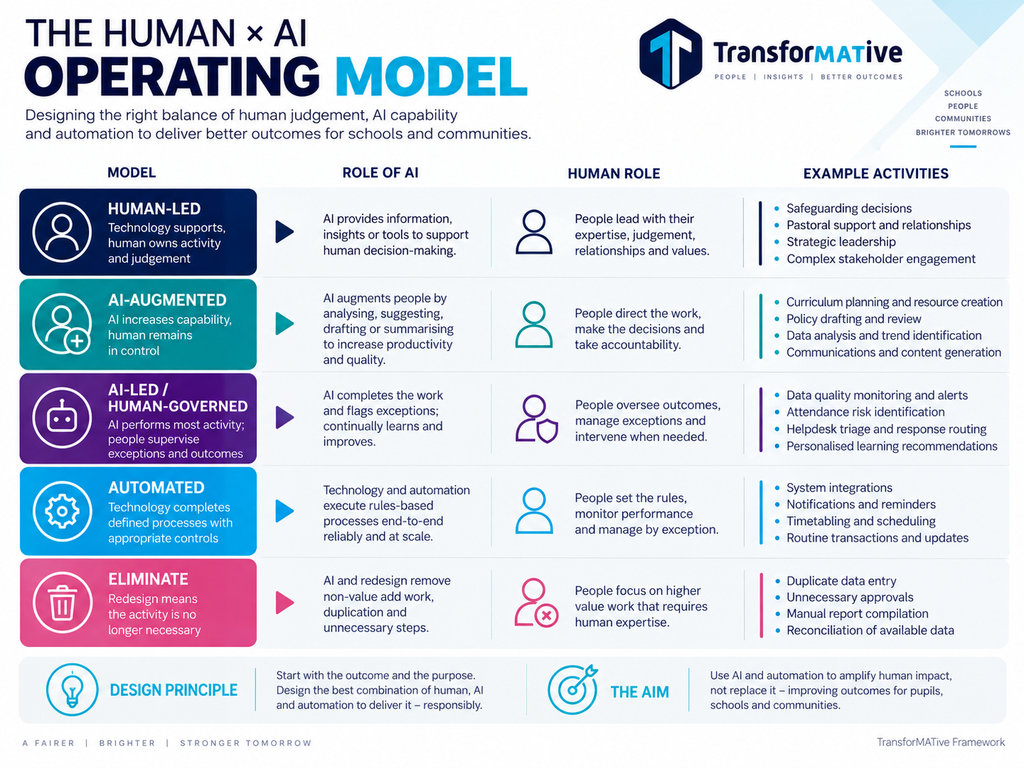
Education leaders are rightly cautious about anything that looks like AI replacing judgement; safeguarding and trust are too central to how schools work for that caution to be misplaced. The right framing isn’t AI-driven. It’s human-led and AI-augmented. Accountability stays exactly where it is; the effort required to get good information in front of the right person is simply reduced.

The part that requires a collective, not a single vendor

Beyond information sharing, if done well, this connected transparency can also create value in a broader way. For example, why should a three-school trust pay more for the same goods and services than a thirty-school trust down the road?

The short answer is often size and scale. Larger trusts with greater spending power can typically negotiate better pricing, better terms, and stronger supplier relationships. This means the MATs with the least capacity to negotiate are often the ones paying the most.

That’s not a systems problem any single trust can fix by buying better software alone. It is something the sector can begin to address when trusts, suppliers and the wider sector connect around models that create greater transparency and collective purchasing power, potentially through something closer to a shared marketplace, with comparable pricing and terms accessible to trusts regardless of size.

That’s the real test of ‘Connect’ as a theme. It’s easy to agree that silos are bad. It’s harder to build something that depends on organisations that do not currently work together choosing to collaborate. A shared procurement model across MATs of every size is exactly that kind of collective effort, and it’s precisely the sort of ambition a Summit like this one exists to explore with the leaders, practitioners and partners who could help make it happen.

Philip Douglas, CEO, Compleat Software

With over two decades of leadership across the technology and SaaS sectors, Philip Douglas brings a unique blend of financial expertise and technology-driven vision to the forefront of digital transformation. As CEO of Compleat Software, he has built a platform that empowers businesses to streamline procurement and finance operations through intelligent automation, seamless integration, and user-friendly design.

Compleat Software

Since 2008, Compleat has been helping schools digitise the entire purchasing process with online purchasing software, allowing all departments to submit purchase requisitions with automated approval workflows based on your chosen criteria, giving finance teams full oversight and control over future cash requirements.

Written by:

Phil Douglas (CEO)

People, Place and Partnership: Reimagining the AI-Enabled School Trust

The current debate around devolution, technical education, accountability and funding points to a wider challenge for school trusts.

How do we build organisations that can continue to deliver purposeful outcomes when policy, structures and expectations continue to change?

Governments will change. Policy will change. Funding models will change.

The purpose of a school trust should not.

Our role is to create the conditions in which children, communities and the people who serve them can thrive.

That means the next phase of digital transformation cannot simply be about infrastructure, devices, systems or standalone AI tools. It has to be about the operating model.

From digital strategy to an AI-enabled operating model

Over the past decade, much of the digital transformation agenda has rightly focused on infrastructure, cloud platforms, cyber security, devices and data.

Those foundations remain essential.

The opportunity now is to think more fundamentally about how work gets done across a trust.

An AI-enabled trust should not be a traditional organisation with an AI product layered over the top.

It should be an organisation designed around better information flow, clearer decision making, reduced duplication and stronger organisational intelligence.

Finance, HR, education, estates, governance and IT should not operate as disconnected functions linked together by spreadsheets and meetings.

The goal should be a more connected operating model where leaders can access the information they need, routine work is simplified or automated, and people have more capacity to focus on the work that requires judgement, relationships and leadership.

The outcome is not fewer people.

It is better use of people’s time.

People

Technology should enable people.

Across school trusts, talented leaders and teams still spend too much time moving information between systems, reconciling spreadsheets, producing reports and completing repetitive administrative processes.

That is an operating model problem.

The starting point should be the work.

What decisions need to be made?

What information is required?

Which activities genuinely need professional judgement?

Which processes exist because systems do not connect effectively?

AI and automation should be used where they reduce friction and release capacity.

They should not replace the human contribution that matters most.

Judgement, creativity, empathy, relationships and leadership remain central to how successful trusts operate.

Place

Place matters.

A rural trust in Lincolnshire will operate in a very different context from a large urban trust in Greater Manchester.

A trust working across several local authorities may experience different approaches to SEND, funding, employer engagement, transport and public services.

That difference should be recognised.

It should not, however, lead to fragmentation.

Trusts should not have to choose between complete centralisation and complete localisation.

A mature operating model can establish common standards for data, identity, cyber security, platforms and governance while still allowing schools and communities to respond to their own context.

There is a simple principle here.

Standardise what should be common. Contextualise what should be different.

Technology can make that balance easier to achieve.

Partnership

The same applies beyond the boundaries of the trust.

If school trusts are expected to act as civic institutions, our operating models need to support genuine partnership.

Education does not sit separately from health, employment, housing, transport, universities, local authorities or employers.

This becomes particularly important when we consider young people who are not in education, employment or training.

Schools can provide excellent education and strong qualifications.

But education cannot create jobs.

If routes into employment are limited, or young people cannot access the opportunities available to them, schools cannot solve that challenge alone.

This is where partnership matters.

Trusts, colleges, universities, employers, local authorities and wider public services need better ways to share insight, understand need and coordinate action.

Technology should help make that easier.

It should support a shift from disconnected systems of record towards better connected systems of intelligence.

Local relevance without local limitation

There is an important distinction to make.

Local employer engagement matters, but vocational education cannot be shaped solely by immediate local labour market needs.

Young people need to be prepared for a much wider economy.

That means developing transferable knowledge and skills, digital capability, adaptability and the confidence to move between sectors, places and opportunities.

The jobs available locally today may not be the jobs available in ten years.

The same principle should apply to how trusts design their operating models.

They should respond to place without becoming constrained by place.

Purpose before politics

Education operates within a political environment.

Different governments will have different priorities, different policies and different views about how public services should work.

Trusts need to be capable of responding to that change without constantly redesigning the organisation around the latest policy announcement.

That requires organisational capability.

Strong governance.

Clear data.

Secure and interoperable systems.

Distributed leadership.

Trusted partnerships.

Responsible use of AI and automation.

These are not political positions.

They are the foundations of a resilient organisation.

A strong operating model should allow a trust to absorb change without destabilising the organisation responsible for delivering it.

The opportunity for school trusts

The future trust operating model should be more connected.

People connected to information.

Schools connected to communities.

Trusts connected to partners.

Leaders connected to the insight they need to make better decisions.

Technology should sit underneath that model, enabling it rather than defining it.

AI has a role to play, but it is not the strategy.

The strategy is to build organisations that are more connected, more responsive and better able to turn information into action.

Digital transformation should therefore be judged by more than whether systems have been modernised.

It should be judged by whether the organisation is better able to deliver purposeful outcomes through people, place and partnership, regardless of the politics of the day.