
Uncategorised
Listening to Jane Simpkins (Head of Teaching and Learning) present Waterton Academy Trust’s teaching and learning framework, what stood out immediately was the clarity and discipline behind it. This is not a collection of initiatives. It is a coherent, evidence-informed approach built on strong foundations such as the EEF, cognitive science and Rosenshine’s principles.
Naturally, I wanted to reflect on this through a digital lens so this post will attempt to converge the Teaching and Learning framework with Porters Value Chain model using technology as an enabler.
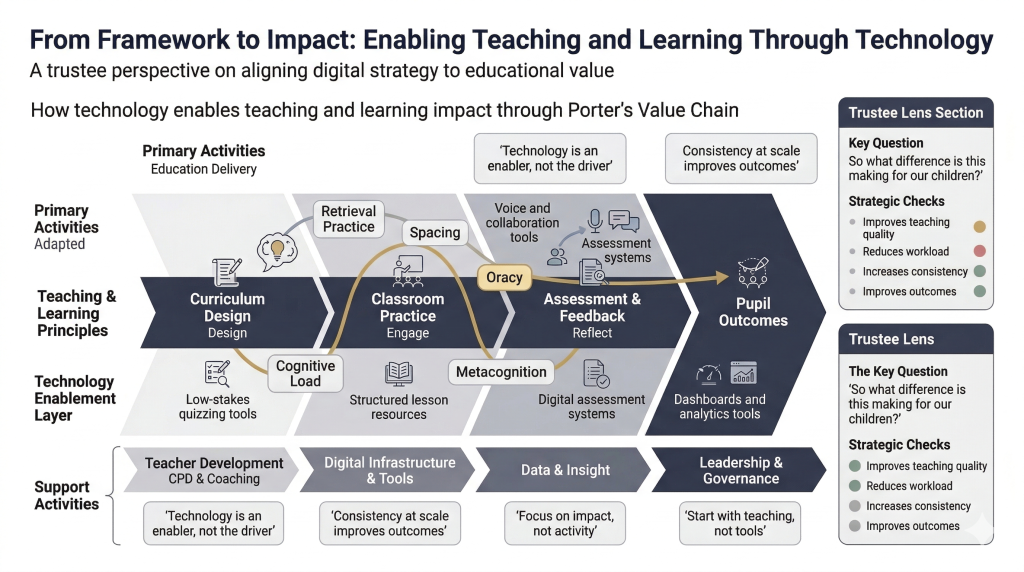
At its core sits a simple structure: design, engage, reflect. Clear, practical and rooted in what works.
As trustees, our role is not to lead pedagogy. It is to ensure that what is being implemented delivers impact. That means outcomes for children, not activity for its own sake.
Which leads to an important question.
Where does technology genuinely add value in this model?
Technology as an Enabler
There is a tendency across the sector to position technology as a driver of change. In reality, the framework Jane outlined makes something very clear. The driver is high quality teaching, grounded in evidence.
Technology has a role, but it is an enabling one.
From a strategic perspective, every decision around digital should align to Porter’s value chain. It should strengthen how the organisation creates value, not introduce complexity or distraction.
That means focusing on areas such as:
- improving curriculum delivery
- strengthening teacher capability
- enhancing assessment and feedback
- providing better insight for leadership
If a digital investment does not support one of these, it is unlikely to deliver meaningful educational value.
Where Technology Can Strengthen Practice
Jane’s focus on retrieval, spacing, cognitive load, metacognition and oracy provides a strong foundation. These are proven approaches. The opportunity is to use technology to embed them consistently and at scale.
Retrieval Practice
Retrieval is rightly gaining attention because it works.
Technology can support this through:
- simple, low stakes quizzing tools
- consistent retrieval routines across classrooms
- insight into gaps in knowledge
The value is not the tool itself. It is the consistency and visibility it enables.
Managing Cognitive Load
Reducing cognitive overload is critical for effective learning.
Technology can help by:
- standardising lesson resources and structures
- supporting modelling through visualisers or recorded explanations
- allowing pupils to revisit content at their own pace
This improves the quality and consistency of teaching without adding unnecessary burden.
Oracy and Inclusion
Oracy was positioned as a golden thread across the trust. This is particularly important for disadvantaged pupils.
Technology can support this through:
- tools that allow pupils to record and reflect on their thinking
- collaborative platforms that encourage participation
- support for vocabulary development
The outcome is improved engagement and stronger access to the curriculum.
Metacognition and Feedback
Helping pupils understand how they learn is powerful but requires structure.
Technology can enable:
- self assessment and reflection over time
- clearer feedback loops
- better tracking of progress
This supports independence and provides teachers with more meaningful insight.
Governance and the ‘So What’ Question
One of the strongest messages in the session was the importance of asking, “So what?”
Technology can support governance by:
- providing clearer, more timely data
- linking teaching approaches to outcomes
- enabling better conversations at board level
The aim is to move from reporting activity to understanding impact.
A Strategic Discipline
There is a risk that digital strategy becomes driven by tools rather than purpose.
As trustees, we should remain disciplined. Not every digital decision needs to be a pedagogical one.
Instead, we should be asking:
- Does this improve the quality of teaching?
- Does it reduce unnecessary workload?
- Does it improve consistency across the trust?
- Does it lead to better outcomes for pupils?
If the answer is unclear, then the case for change is weak.
Final Reflection
What Jane presented was not complex, but it was rigorous. That is where its strength lies.
Technology should not sit alongside this work as something separate. It should sit beneath it, quietly enabling it to scale, to embed and to sustain.
From a trustee perspective, the priority is straightforward.
Every decision, including digital, should strengthen the organisation’s ability to deliver high quality education.
And ultimately, it should always come back to one question.
What difference is this making for our children?