
Merger
In the schools sector we often talk about growth. More schools, more scale, more influence. But growth alone is rarely the right question.
Listening to Alan Warboys speak about the proposed merger between Accord Multi-Academy Trust and Maltby Learning Trust was a useful reminder that the real question is always why.
Throughout the two-year process, the leadership teams have kept returning to a single test:
Will this be the best thing for our children and communities over the next ten years?
That framing matters. It shifts the conversation away from organisational mechanics and towards long-term impact.
A merger of equals is harder but healthier
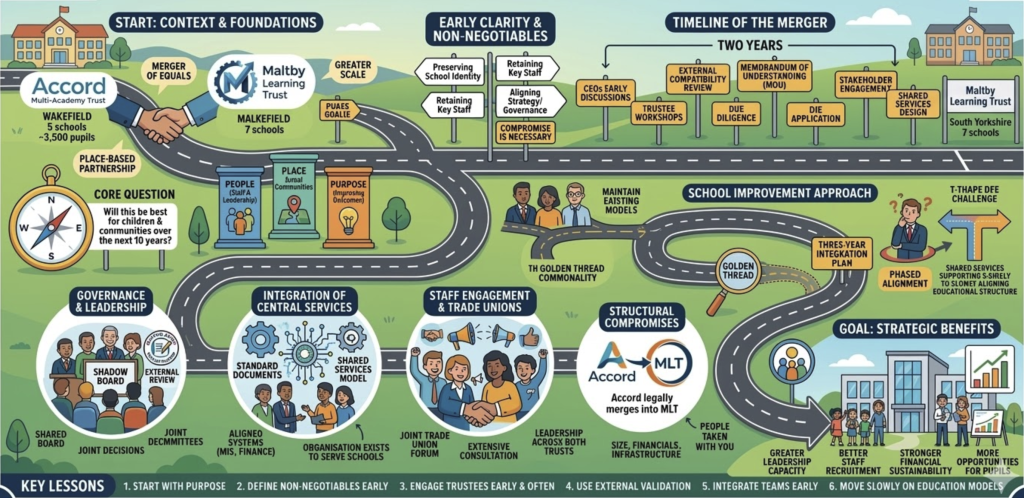
Accord, with five schools in Wakefield, and Maltby Learning Trust, with seven schools across Doncaster and Rotherham, are broadly similar in size and performance. Rather than one trust absorbing the other, the intention has been a merger of equals.
That makes things more complicated.
Governance needs redesigning. Structures need negotiating. Cultural assumptions need surfacing. Compromise becomes unavoidable.
But it also forces deeper collaboration. If neither organisation is taking over, both have to build something new together.
Start with the non-negotiables
One of the most practical lessons from the session was the importance of early clarity.
Before progressing, both trusts defined:
- what they wanted from the merger
- what they would not compromise on
- where compromise would be necessary
Key principles included preserving school identity, retaining key staff, and aligning strategy and governance without destabilising existing improvement work.
Without that clarity, the inevitable complexity of a merger can easily become conflict.
Integration happens at different speeds
Operational alignment can happen relatively quickly. Educational alignment should not.
The trusts began integrating teams early, aligning systems such as MIS and finance, and designing a shared services model. Notably, they intentionally moved away from the term central team. It is a useful reminder that the organisation exists to serve schools, not the other way around.
But when it came to school improvement, the approach was deliberately cautious.
Both trusts already had strong models. Rather than impose one immediately, they designed a three-year integration period. The aim is to identify the “golden thread” between them and gradually align practice over time.
That kind of patience is rare but probably wise.
Governance is the backbone
Another strong theme was the role of trustees.
Sub-committees from each trust worked together. An external review tested organisational compatibility. A shadow board brought trustees from both organisations into joint decision-making.
In many ways, governance led the process rather than simply approving it.
People first
Perhaps the most important message was about people.
Staff consultation has been extensive. Central teams have worked together early. Trade unions were brought into a joint forum. Leadership teams have collaborated across both trusts long before the merger completes.
You cannot merge organisations without bringing people with you.
Purpose, place and the next decade
Ultimately, the ambition is not simply a larger trust.
It is a place-based partnership with greater capacity, stronger leadership pipelines, and improved opportunities for pupils across the region.
That ambition is grounded in three ideas that kept resurfacing during the session:
- People – supporting and retaining the staff who make schools work
- Place – strengthening local partnerships and communities
- Purpose – improving outcomes for children
Scale, when it comes, should serve those things, not replace them.
In a sector where mergers are becoming more common, Warboys’ reflections felt like a useful compass.
Start with purpose.
Be clear about what matters.
Move carefully where it counts.
And always keep the ten-year question in view.
A final thought on digital
One theme that often sits quietly beneath mergers like this is digital transformation.
Aligning systems, integrating data, rationalising platforms, and designing shared services all depend on technology decisions. These choices shape how efficiently the new organisation operates and how easily schools can work together.
It raises an important question for any trust considering a merger:
Who is leading the digital transformation that sits alongside the organisational one?
The technical work often determines how smooth the integration feels for staff and schools.
If your trust is navigating a merger, or considering one, and thinking about the digital implications, it would be great to talk. At Transformative we work with trusts on exactly these challenges, helping leaders align technology, strategy and operations during periods of structural change.
If we can be helpful, please do get in touch.