
Artificial Intelligence
By Jonny Wathen, CEO, TransforMATive
A recent keynote on AI in education raised a simple but useful point: information is not expertise.
AI has changed access to information. Teachers, leaders, parents and students can now get answers to complex questions almost instantly. But an answer is not the same as professional judgement.
In education, context matters. A teacher knows the child, understands the circumstances around them and can draw on experience, relationships and professional knowledge in a way that an AI tool cannot. AI can identify patterns, summarise information and suggest possible responses. It can be extremely useful. But there is still a person who has to decide whether the output is right, whether it is appropriate and whether it should influence what happens next.

Information, judgement and the role of the educator
We are entering a period where access to information is no longer the challenge it once was. Parents can ask AI about child development, learning expectations, assessment, behaviour or possible support needs before they ever speak to a teacher or school leader. Students can do the same. Staff can use AI to help plan lessons, summarise information, draft communications or analyse data.
That brings real opportunity, but it also creates a new challenge. The issue is no longer simply whether someone can access information. It is whether they can judge the quality of that information, understand its limitations and apply it in the right context.
That is where professional expertise becomes more valuable, not less. A parent may arrive with an AI-generated answer about their child. A teacher still needs to explain what that answer does and does not mean for the individual in front of them. An AI system might identify a pattern in attainment or behaviour. A member of staff may know that the pattern is linked to something happening at home, a change in confidence, a relationship issue or another factor that the data does not capture.
This is particularly relevant in areas such as early years, SEND, safeguarding and pastoral support, where the quality of professional judgement often depends on relationships, observation and knowledge of the individual. No dataset gives a complete picture of a child, and no automated summary can fully explain their confidence, motivation, family circumstances, friendships, emotional wellbeing or how they respond in different environments.
AI can help surface information and identify patterns. Educators still have to interpret what those patterns mean.
Parents, trust and the changing relationship with schools
AI is also beginning to change the relationship between schools and parents. Parents now have access to far more educational information than they could previously, and in many ways that is positive. It can help them understand terminology, prepare questions and engage more confidently with their child’s education.
But more information does not always create more clarity. AI-generated responses can sound confident even when they lack the context needed to make a sensible judgement about an individual child.
That creates a different role for schools. Educators may increasingly need to help families understand the difference between general information and professional advice that is appropriate to a particular child. They also need to be able to explain how AI is being used within the organisation, where its limits sit and which decisions remain firmly the responsibility of a professional.
Trust will depend on that clarity.
Parents should not need to understand every technical detail of the systems a school uses, but they should be able to understand where AI is involved and where human judgement remains central.
Policy, confidence and culture
There is also a danger that organisations confuse having an AI policy with being ready to use AI well.
A policy is necessary, but it is not enough.
Staff need to understand what they can and cannot do. They need to understand why those boundaries exist. They need to know which tools are approved, what information should never be entered into them and where human oversight is required.
Most of all, they need the confidence to say when they are unsure.
There is a risk that the pace of AI development creates an expectation that everyone should already understand it. That is unrealistic. Leaders need to create an environment where questions are normal and where admitting uncertainty is seen as a responsible professional response rather than a weakness.
This is why AI literacy needs to become part of professional development. Not everyone needs to become an expert in AI, but staff do need enough understanding to recognise when it is useful, when it creates risk and when to stop and ask for help.
Compliance is essential, particularly where AI interacts with personal data, safeguarding, assessment or decision-making. But compliance on its own does not create good practice. People are much more likely to make sensible decisions when they understand the principles behind the rules.
Start with trust, not technology
The idea of beginning with trust rather than technology is a useful one.
Do staff trust the organisation’s motives for adopting AI? Do they understand why particular tools have been selected? Do they feel that AI is being introduced to support them, rather than simply reduce cost or remove roles? Do parents know how AI is being used around their children? Can leaders clearly explain where human judgement still sits? Can students understand what responsible use looks like?
These questions sit beneath the technology.
An organisation can procure an AI platform quickly. Building confidence takes longer. Responsible AI adoption therefore needs to be seen as a leadership and cultural challenge, not simply a technology project.
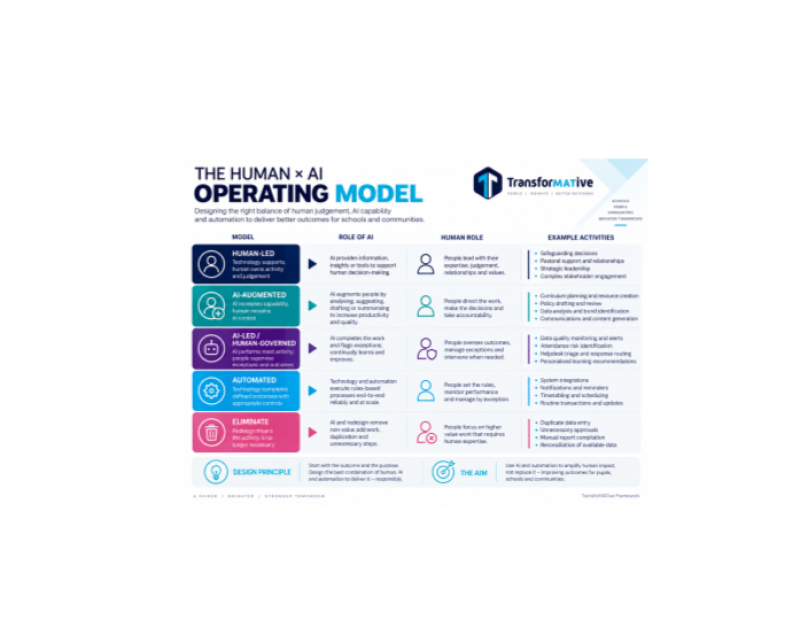
This also means keeping human accountability visible. As AI becomes more capable, leaders will face more decisions about where to allow it to play a role. Using AI to help draft a lesson plan or summarise information is very different from allowing it to influence a judgement about a child.
The further AI moves into areas such as assessment, intervention, safeguarding or communication with families, the clearer accountability needs to be. If AI contributes to an assessment, who reviews it? If it drafts a communication to a parent, who is responsible for the final wording? If it identifies a possible concern, who considers the wider context? If it recommends an intervention, can a professional explain why that intervention is appropriate?
Human oversight should not be a line in a policy. It should be obvious in practice.
Faster does not always mean better
AI can make processes quicker. That is one of its biggest attractions. It can draft, summarise, organise and analyse at a speed that would have been difficult to imagine only a short time ago.
But speed should not be confused with quality.
A polished piece of writing can still be poor communication. A quick analysis can still miss the context. An automated observation can still lack the depth of something written by a professional who knows the child.
The question for leaders is not simply whether AI can complete a task. It is whether using AI improves the outcome.
Sometimes it will. Sometimes it will not. And sometimes the act of completing the task is itself part of the professional thinking that we should be careful not to remove.
That is why AI should not sit with one team or one policy. It touches leadership, curriculum, pedagogy, data protection, safeguarding, workforce development, governance and organisational culture.
People need clarity about expectations and boundaries. They need the confidence and capability to use tools well. There needs to be transparent communication with staff, parents and other stakeholders. There also needs to be appropriate governance, assurance and accountability.
A policy without staff understanding will struggle. Training without clear boundaries creates risk. Governance without communication can weaken trust. Technology without a clear educational purpose becomes noise.
Questions for education leaders
As AI becomes more established across education, there are some practical questions worth asking. Can staff explain when and how AI should be used? Do they understand its limitations as well as its benefits? Would they feel comfortable admitting that they were unsure about something? Can parents understand how AI is being used around their child? Are there clear areas where human judgement must remain central? Do leaders know what happens to information entered into the tools their staff are using? Are AI-generated outputs properly reviewed before they influence decisions? And are we measuring whether AI is actually improving education, rather than simply making processes faster?
These are leadership questions, but they are also governance questions.
The human role does not disappear
AI will continue to improve. It will become part of more of the platforms we already use and, in many cases, we may stop noticing that it is there.
That should not be a reason to resist it.
But neither should it become a reason to hand over judgement too quickly.
Education remains a human endeavour. Teachers bring experience, context, relationships, empathy and professional judgement. Leaders bring responsibility and accountability. Parents bring knowledge of their children. Students bring their own voice and experience.
AI can support all of that.
It should not displace it.
The goal should not be to become the organisation using the most AI. It should be to use it in ways that are safe, sensible and genuinely improve education.
And the best place to start is not with the technology.
It is with trust.