A pupil who doesn’t feel they belong at school is, on average, doing worse. Not slightly worse, but close to a full GCSE grade worse across their entire set of results. That’s the headline from research commissioned by the Department for Education. For trust leaders, it provides some of the clearest evidence yet that wellbeing and academic attainment are not separate agendas competing for the same time, resource, and budget. They are fundamentally connected.
A central focus of the TransforMATive Digital Leadership Summit is how multi-academy trusts move beyond siloed systems and build genuinely connected intelligence. This research challenges executive teams to look closely at their own digital ecosystems. The DfE study analysed survey responses from 4,763 pupils in 165 English schools, linking their answers about school belonging directly to their Key Stage 4 attainment data. In doing so, it connects what pupils say about their lived experience of school with their measured academic outcomes demonstrating why digital and data strategies must do the same.
A GCSE grade’s worth of difference
The research measured pupils’ sense of belonging against their Attainment 8 scores, the metric that averages a pupil’s results across eight GCSE subjects. After accounting for prior attainment, pupil characteristics and bullying, pupils who strongly disagreed that they belonged at school scored 7.72 points lower on average than those who strongly agreed, a gap equivalent to almost a full GCSE grade across all eight subjects. Pupils who simply disagreed, without feeling strongly about it, scored 4.02 points lower. The DfE is careful to note that this shows an association rather than proven cause and effect, but the scale of the gap is hard to ignore.
Which pupils report lower levels of school belonging?
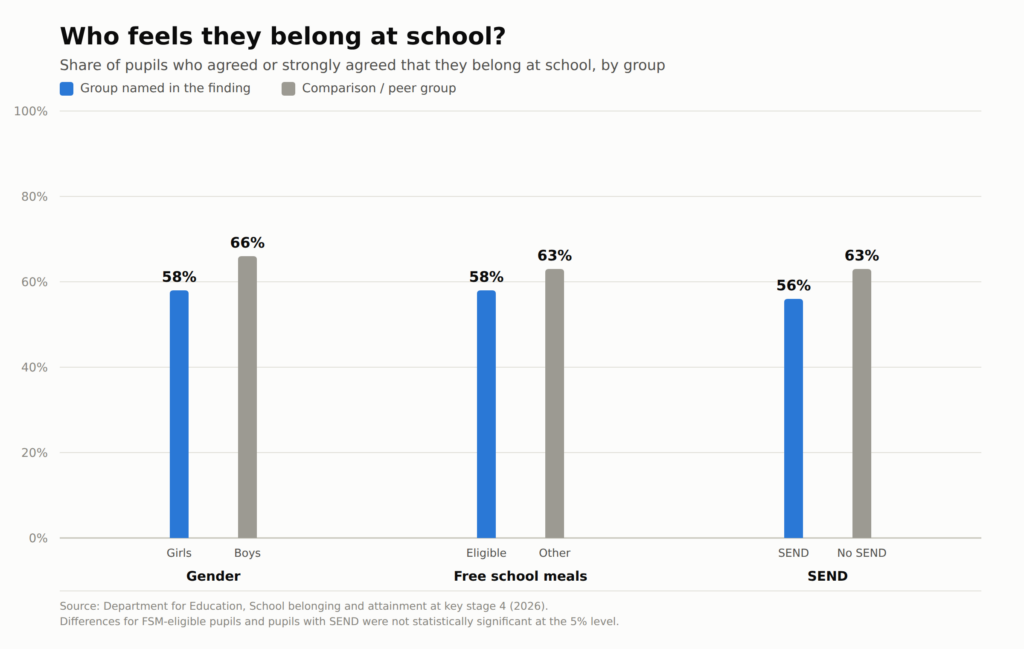
The same research found clear disparities in reported belonging. Girls, pupils eligible for free school meals (FSM) and pupils with SEND were less likely to say they felt they belonged at school than their peers, although the differences for FSM and SEND were not statistically significant at the 5% level.
58% of girls felt they belonged at school, against 66% of boys
58% of pupils eligible for free school meals felt they belonged, against 63% of other pupils
56% of pupils with SEND felt they belonged, against 63% of pupils without
These are exactly the groups schools already spend the most pastoral effort trying to support. In light of these findings, having a reliable way to measure belonging, rather than infer it, more useful than ever.
The government’s approach to measuring school belonging
The findings add weight to a direction of travel already set out in the DfE’s Every Child Achieving and Thriving white paper, which sets out an explicit ambition: every school monitoring pupils’ sense of belonging and engagement by 2029, through a planned pupil engagement framework, up from around 60% of schools doing so today. That ambition isn’t sitting on a shelf: in April, the first major piece of wellbeing-focused legislation – The Children’s Wellbeing and Schools Act 2026 – received royal assent. While the Act doesn’t put wellbeing monitoring on a statutory footing itself (that’s still due through the separate pupil engagement framework), it shows a government moving from writing ambitions down to legislating for them. This legislation follows the same logic already built into Ofsted’s current framework, which grades schools on ‘personal development & wellbeing’ as a standalone judgement area.
Put together, the direction of travel is clear. Wellbeing monitoring is moving from good practice to expectation. School leaders can be getting ahead of expectation and embedding best-practice before it’s required by ensuring they have a reliable way to track wellbeing today.
What it means for FE and training providers
Attainment 8 is a schools-only measure, so this particular study doesn’t speak directly to post-16 outcomes. However, there is a parallel shift in post-16 inspection towards making learner wellbeing, belonging and participation more explicit. Under Ofsted’s renewed framework, ‘participation and development’ is a graded evaluation area, and inspectors consider whether learners belong, feel valued and are supported to thrive.
Separate research from the Association of Colleges found that 88% of responding colleges identified poor mental health as one of the top three reasons for poor student attendance in 2023/24, up from 50% before the pandemic. The 2024/25 survey paints a starker picture still: 90% of colleges reported an increase in 16-18 year-olds disclosing mental health issues, and 74% reported an increase in suicide ideation in the same age group over the previous year. The AoC have laid out a Mental Health Charter, which sets out standards colleges can work towards.
These data points confirm that the underlying question – “do you actually know how your learners are doing, beyond attendance and grades?” – is the key question to be asking.
You already have a way to measure this
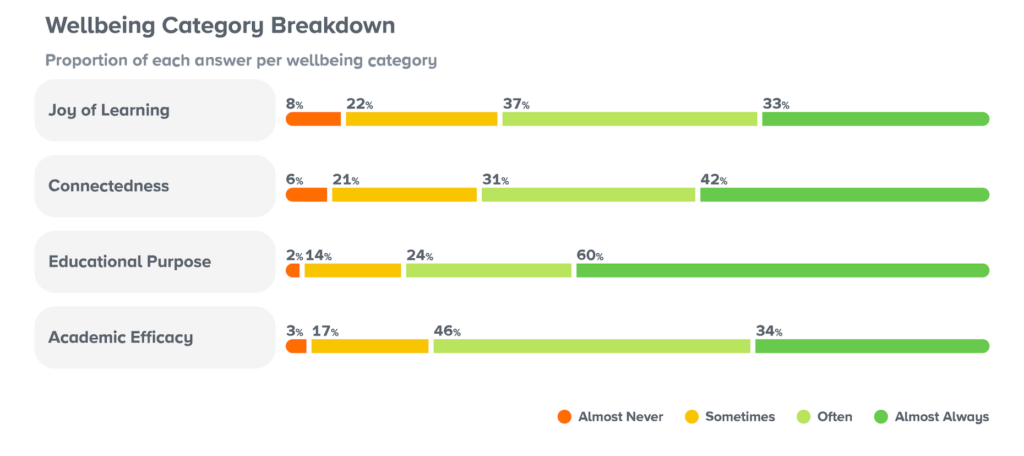
This is precisely the question the CENTURY Wellbeing Tool was built to answer, and it’s included in every CENTURY subscription at no extra cost. Built on the validated Student Subjective Wellbeing Questionnaire, it takes a learner under five minutes to complete and reports back across five domains: connectedness, academic efficacy, joy of learning, educational purpose and safety. Reporting is immediate and confidential, with safety flags for anyone who may need immediate support.
You can run the questionnaire as often as you like: our recommendation is to do a termly check in with the tool to get a picture of belonging alongside the academic data you already track on CENTURY. We covered how the tool works in more detail in our article Supporting Every Learner.
Government policy is inevitably heading towards a world where every school and college can answer, with evidence, whether their pupils and learners feel they belong. However, what a school or trust does with a term’s worth of data is the part that actually moves the dial, and it is a question worth returning to on its own.
For now, the practical starting point is ensuring you are capturing that data seamlessly. CENTURY customers already have the Wellbeing Tool to do this built directly into their platform at no extra cost, allowing them to view a picture of belonging alongside the academic data they already track.
The answer to better trust-wide insight is not always more technology; sometimes, it is making what we already have work better together.
Connected Intelligence with TransforMATive & CENTURY Tech
This challenge of linking strategic ambition with practical, trust-wide delivery lies at the core of CENTURY Tech’s involvement in the TransforMATive Digital Leadership Summit at the University of Leeds.
Through CENTURY’s “Connected by Design?” digital leadership health check framework, trust leaders can systematically evaluate how strategy, people, systems, and data work together to drive meaningful impact across their schools.
Why Seeing Teaching Clearly Is Not the Same as Improving It
Written by Danielle Finlay, October 2026
Abstract
Every conference about the future of education now promises greater visibility: better dashboards, richer data and more connected systems that help leaders see what is happening in classrooms. Written for a conference exploring how leadership, technology and organisational practice can combine to transform education, this article argues that visibility is a beginning, not a destination. Drawing on research into judgement, organisational culture and school improvement, alongside an anonymised leadership experience from a multi-academy trust, it considers how greater visibility can support better decisions, but can also accelerate weak ones when seeing is mistaken for understanding. The central claim is simple: technology is the vehicle. Whether that vehicle moves an organisation towards genuine improvement depends on the culture, judgement and behaviour of the leaders driving it. The article proposes a discipline, Know, Interpret, Act, Learn, through which visibility can become wiser rather than merely faster decision-making.
Introduction: The Question Behind the Conference
I am writing this a few weeks before I stand in front of a room of trust chief executives and system leaders at the TransforMATive Digital Leadership Summit, an event exploring how leadership, technology and organisational practice can combine to transform education. I believe technology can play a powerful part in that transformation, or I would not have spent the last several years of my career engaging with, and more recently leading, a platform designed to support it. But I want to use this piece to challenge one assumption that can sit too easily alongside conversations about educational technology: that greater visibility necessarily leads to better decisions.
Visibility is not the same as improvement. Seeing more of teaching does not automatically mean understanding it better. A sector that is becoming more instrumented, more dashboarded and more data-rich is not thereby becoming more insightful. In some organisations I have worked in and with, the more visible teaching became, the more important it was for leaders to slow down their interpretation, precisely because visibility arrived faster than the judgement required to use it well.
This is not an argument against technology. It is an argument about what technology is for, and what it is not for. Technology is the vehicle. It can connect evidence, expose patterns and move an organisation somewhere. It cannot decide where that organisation should go, or whether what has become visible is sufficient to justify action. Those decisions, and the culture in which they are made, belong to leaders.
That is the argument of this piece: visibility must come before judgement, but visibility is a beginning, not an answer. I will draw on research into decision-making, organisational culture and school improvement, and on my own experience leading through this tension, to make the case for a discipline that converts what technology reveals into something worth calling insight.
The Familiar Shape of the Problem
Ask any group of trust leaders whether they lack information about teaching, and the answer is almost never yes. Most schools and trusts I have worked in are rich in evidence: lesson visits, book looks, pupil voice, CPD logs, appraisal targets, learning walks and coaching records. The problem is rarely a shortage of activity intended to improve teaching. It is more often a problem of connection and interpretation.
Four patterns recur with striking regularity across contexts that otherwise look very different.
The first is disconnection. Lesson visits happen in one system, feedback lives in another, CPD is planned in a third, and appraisal sits in a fourth. Each activity is defensible in isolation. Collectively, they do not always add up to a coherent account of what the organisation understands about its own teaching.
The second is variable interpretation. Leaders can observe the same practice and reach meaningfully different conclusions, not necessarily because any of them is wrong, but because they are applying slightly different, often unarticulated, theories of what great teaching looks like. At trust scale, that variation can become inconsistency that teachers experience as unfairness.
The third is blanket action. A leader notices a pattern, perhaps in one department or from a small number of visits, and the response becomes a whole-school programme. Precision is sacrificed for the appearance of decisiveness, while the people who most need support may receive the same generic response as everyone else.
The fourth is initiative fatigue. Activity accumulates. Frameworks are launched and then quietly superseded. Staff experience change not as progress but as churn, with another priority added before the previous one has been properly evaluated or embedded.
None of these patterns is caused by a lack of commitment. What is often missing is architecture: the connective tissue that allows one piece of evidence to inform the next, one leader’s interpretation to be tested against another’s, and one action to be evaluated before a further response is added (Fullan and Quinn, 2016; Bryk et al., 2015).
This is where the promise of education technology becomes both useful and demanding.
The Visibility Trap
The seductive version of the story goes like this: fragmentation is a data problem, and data problems have technological solutions. Bring every signal into one place, present it clearly enough, and the fog lifts. Leaders will finally see their organisation as it really is.
That promise is only half true.
Daniel Kahneman’s work on judgement offers an uncomfortable starting point. Human beings are highly susceptible to substituting a difficult question for an easier one, particularly under time pressure and when information feels abundant (Kahneman, 2011). When faced with the demanding question:
What does this tell us about practice over time and context?
It is far easier to answer a different one:
What does this snapshot suggest?
Data does not protect leaders from that substitution. It can give an answer a sense of legitimacy that intuition alone does not.
Jerry Muller’s critique of metric fixation sharpens the point. Once an indicator exists, there is a strong institutional pull towards treating it as a proxy for the complex reality it was only ever meant to represent, and then towards managing the proxy rather than the reality (Muller, 2018). A dashboard showing repeated weak drop-ins in a department can very easily become “the department with a problem”, when a slower, triangulated account might tell a more complicated story.
This is the visibility trap: seeing more can feel like understanding more, when it may simply move leaders faster, and with greater apparent authority, towards conclusions the evidence does not yet support. The clearer the picture becomes, the more disciplined leaders must be about what it allows them to say reliably.
Let me tell you how that lesson can play out in practice.
The Trust That Saw Too Much, Too Soon
A few years ago, while working across a multi-academy trust, I reviewed typicality data drawn from lesson visits across a number of schools. Something in the pattern did not sit right. Some schools with a history of weaker outcomes were showing a noticeably higher proportion of teachers evaluated as meeting the expected standard than schools with a longer record of stronger performance.
Read quickly, that looks like good news. Read against other evidence, including pupil outcomes, external validation and the longer-term trajectory of those schools, it raised a different question.
The temptation was to take the data at face value. Instead, we treated the pattern as a prompt for enquiry rather than an answer:
What does “expected standard” actually mean, in practice, across these schools?
How consistently are our leaders applying and moderating it?
Are different local contexts shaping how reassurance and accuracy are being balanced?
We commissioned a cross-school calibration process rather than a review of individual staff: joint learning walks, moderated discussion of evidence gathered through our platform, and structured professional dialogue between leaders working in contrasting contexts. What we found was not that teaching in some of our historically weaker schools had quietly become stronger than teaching in our strongest ones. It was that leaders emerging from a period of sustained difficulty had, understandably and with good intentions, adopted a more generous interpretation of what “expected” meant while trying to rebuild confidence.
This was not a failure of professionalism. It was a cultural signal about how reassurance and accuracy were being balanced under pressure, and it would have been difficult to see without the data. It would also have been easy to misread through the data alone. Had we treated the pattern as a verdict rather than a prompt for enquiry, we would have drawn the wrong conclusion at precisely the moment our confidence in the platform’s visibility was highest.
The correction was not to distrust the technology. It was to recalibrate what “expected” and “excellent” meant in practice, using shared exemplars and moderated professional dialogue, and to make clear that accuracy was not a punishment. Only when diagnosis is honest can support be targeted where it is genuinely needed (Kahneman, 2011; Wiliam, 2011).
Just as importantly, the way we approached that recalibration mattered. Leaders went into those schools to understand how the judgement had been formed, not simply to correct it. We acknowledged the context those schools had travelled through and treated the centre as a partner asking a hard question alongside them, rather than an inspectorate arriving with a verdict. That protected the trust required for the recalibration to become useful rather than defensive (Bryk and Schneider, 2002).
I share this story because it is the clearest illustration I have of the difference between visibility and understanding. The platform did exactly what it was designed to do: it made a pattern visible that might otherwise have remained hidden inside separate sets of local judgement. What it could not do was tell us what that pattern meant. That interpretation depended on leaders willing to be curious rather than reassured, and on a culture in which an uncomfortable question about our own data could be experienced as rigour rather than disloyalty.
The Vehicle and the Driver
This is where I want to return to the framing behind this piece.
Technology is the vehicle. It is genuinely capable of moving an organisation somewhere: connecting evidence that would otherwise stay scattered across notebooks, inboxes and individual memory; making patterns visible at a scale no single leader could hold in their head; and preserving a professional conversation so it does not have to be reconstructed every time a new leader joins the organisation. All of that is real, and none of it is trivial.
But a vehicle does not choose its destination, and it does not know when it has arrived somewhere true rather than somewhere merely visible. Nor does it take account of who is travelling and how they experience the journey. That is the work of leadership behaviour and the culture it creates.
Edgar Schein’s distinction between climate and culture is useful here (Schein, 2010). A new platform, however sophisticated, interacts first with the current climate around feedback, scrutiny and change. Only when leadership behaviour around that platform is consistent, visible and trusted over time does technology become part of a healthier organisational culture (Bryk and Schneider, 2002).
This is why the same technology can produce very different experiences in different organisations. Where leaders invite challenge to their own interpretation of the data and treat patterns as prompts for professional dialogue, visibility is more likely to be experienced as support. Where data is used as a verdict to be delivered, the same technology can feel like surveillance, whatever language is used to introduce it.
The determining variable is not only the sophistication of the platform. It is whether leaders have created enough psychological safety for a difficult pattern to be discussed honestly, without the person closest to the practice feeling that they must first protect themselves from what the data appears to say about them (Edmondson, 1999; Edmondson, 2019). Feedback is only developmental when it helps someone adjust their practice confidently, purposefully and without fear of judgement (Hattie and Timperley, 2007). That is a discipline of leadership behaviour, not a feature of a dashboard.
None of this is an argument for slowing the adoption of better technology. It is an argument for recognising that technology alone was never going to do the hardest part of the work. The vehicle can travel considerably faster now than it could five years ago. Whether it takes an organisation somewhere worth going still depends on who is driving and what their people have learnt to trust.
Clarity Before Technology
There is a prior question that too many organisations skip in their rush towards greater visibility, and it has little to do with data.
Before leaders attempt to measure teaching consistently, they need enough shared clarity about what they believe great teaching looks like and why. A shared pedagogical framework can support this work, but it cannot substitute for it. Codification has to follow genuine professional agreement about educational purpose, rather than creating the appearance of consensus through a rubric alone (Shulman, 1987; Biesta, 2013).
The absence of that clarity usually appears first in the everyday mechanism of feedback. Without a shared, durable understanding of what great teaching looks like here, feedback can become tied to whatever the current rubric happens to measure, episodic rather than developmental, and responsive to whichever pattern has surfaced most recently. Each individual piece of feedback may be accurate and well-intentioned, yet still fail to accumulate into a coherent direction for professional growth (Hattie and Timperley, 2007).
I have watched organisations invest heavily in visibility while remaining privately unclear about what they were trying to see. Ask ten leaders to describe great teaching in their own trust and they may give ten different answers, not because they disagree fundamentally, but because the underlying clarity has never been forced into the open. When that happens, a platform does not resolve the confusion. It scales it.
This is why I now think of technology’s most valuable early contribution not as insight, but as exposure. It makes an organisation’s existing lack of clarity visible more quickly by forcing leaders to notice when their interpretations diverge. Used well, that discomfort becomes the beginning of the real work: building the shared language and pedagogical identity on which any credible system of visibility depends (Senge, 2006).
The leadership task is therefore not to eliminate disagreement quickly. It is to create the conditions in which disagreement can be surfaced, examined and resolved well enough to create genuine shared understanding. Going slowly enough to have that argument properly is often what allows an organisation to move faster, and more consistently, afterwards.
This is how we help leaders to see clearly, act proportionately and improve deliberately.
From Judgement to Enquiry
If visibility should not be trusted to deliver its own interpretation, what discipline should leaders put in its place?
I have come to rely on a simple sequence, developed through years of exactly the mistakes described above: know, interpret, act, learn. To know is to build an increasingly reliable understanding of what is happening, while remaining honest about what the evidence cannot yet tell us. To interpret is to bring context, professional expertise and more than one perspective to that evidence before deciding what it means. To act is to respond proportionately, through coaching, professional development, further enquiry or deliberate non-intervention. To learn is to return to what happened next and let that experience refine what the organisation understands, rather than treating the original judgement as final.
The discipline lives or dies between interpretation and action. A pattern is often noticed and a response generated in the same breath, without the intervening question of what kind of response the evidence actually warrants. An isolated occurrence in one classroom is not the same evidence as a pattern repeated across a department, a phase or a trust, and treating them identically is an expensive mistake (Bryk et al., 2015).
The table below sets out the distinction I try to hold onto whenever a pattern lands on my desk.
What the Pattern Is
What It Might Warrant
What It Does Not Warrant
Isolated, a single observation
A conversation; further evidence gathering; professional curiosity
A whole-school response; a formal judgement about the individual
Repeated within one team or department
Targeted coaching; subject-specific professional development
Immediate trust-wide policy change
Consistent across multiple, unrelated contexts
Investigation into curriculum, systems or leadership conditions
Individual blame; isolated coaching alone
Strong practice, recurring
Recognition; sharing as a model for others
Silence; treating strength as unremarkable
None of these responses can be found in a dashboard. A platform can show a leader that a pattern exists. It cannot tell them whether that pattern reflects an isolated moment, a genuine department-level need, or a system-level condition that individual coaching alone will not resolve (Argyris and Schön, 1978). That judgement belongs to the leader willing to ask what else might explain it, and to accept that their first interpretation may be wrong.
This is, I think, one of the most important leadership skills of the next decade: not the ability to gather evidence, which our sector is rapidly becoming good at, but the discipline to ask a better question before reaching for a bigger response.
What This Means for the Trust You Lead
Everything above matters more, not less, at trust scale.
A single headteacher can, with effort, hold a reasonably complete picture of their own school in their head. A trust CEO leading many schools cannot and should not try to. The temptation at scale is to resolve that impossibility through aggregation: bring everything into one dashboard, compare schools against each other and treat variation as a problem to engineer away.
Variation between schools is not, in itself, evidence of inconsistency. Different curricula, demographics, staffing histories and stages of improvement will legitimately produce different pictures. The leadership discipline at trust level is not to remove variation, but to develop enough shared language and trust between leaders that variation can be discussed honestly rather than defended or hidden (Fullan, 2016; Spillane, 2006).
The distinction worth naming here is between aligned autonomy and enforced standardisation. Alignment belongs to the north star: a shared, codified understanding of what great teaching means and why it matters. Autonomy belongs everywhere alignment does not need to reach: the curriculum choices, staffing decisions and pace of improvement that only make sense inside a school’s own history and context. Strong trusts resist the temptation to mistake tight alignment for a licence to standardise everything beneath it. They hold the purpose firmly while allowing leaders to own their context (Fullan and Quinn, 2016).
A platform bought once and left to run will drift towards the visibility trap described earlier. No system stays calibrated to an organisation’s evolving understanding of its own teaching without ongoing leadership attention. Organisations that use visibility well treat their platform, pedagogical framework and professional judgement as things to refine together, not to configure once and consider solved (Fullan and Quinn, 2016).
A useful test is to ask four questions:
Where do our shared beliefs about great teaching and what the evidence shows genuinely agree?
Where are we confident that the north star is shared, but have not tested that belief?
What is the platform surfacing that we have not yet sat with long enough to interpret?
What question about our own teaching have we not yet thought, or dared, to ask?
Sit with whichever question makes you least comfortable. That discomfort, not the dashboard, is where the harder work of this piece begins.
Conclusion: What Are We Actually Trying to Transform?
A conference organised around transformation invites an obvious question worth asking directly: transformation of what, exactly? If it means the sophistication of our dashboards and the speed of our data, education technology is already delivering and will continue to. If it means the quality of teaching that children experience, day after day, then the sophistication of the vehicle is only one part of the answer.
Genuine transformation depends on whether leaders build the culture, shared language and discipline of enquiry that allow visibility to become insight rather than merely faster judgement. Technology can preserve professional memory, connect evidence that used to sit in separate systems and reveal patterns no single classroom visit could show. What it cannot do is decide what those patterns mean, create the psychological safety required for teachers to engage honestly with what they reveal, or replace the sometimes uncomfortable work of building a shared understanding of great teaching.
I said at the start of this piece that visibility must come before judgement. That does not mean judgement can wait indefinitely, or that leaders should hide behind further data-gathering to avoid difficult decisions. It means the quality of the judgement leaders make should never outrun the quality of the understanding on which it depends, however urgent, visible or confidently presented the information may be.
The vehicle is not the driver. As technology becomes more capable, persuasive and embedded in how we lead schools and trusts, that distinction becomes more important. The organisations that transform teaching over the next decade will not do so through sophisticated platforms alone. They will be the ones whose leaders keep asking what their technology is actually showing them, and who build the culture, courage and shared language required to ask that question honestly, together, especially when the data suggests an answer that feels a little too easy.
See clearly. Act proportionately. Improve deliberately.
Fullan (2016); Fullan and Quinn (2016); Spillane (2006)
Reference List
Argyris, C. and Schön, D. A. (1978) Organizational Learning: A Theory of Action Perspective. Reading, MA: Addison-Wesley.
Biesta, G. (2013) The Beautiful Risk of Education. Boulder, CO: Paradigm.
Bryk, A. S. and Schneider, B. (2002) Trust in Schools: A Core Resource for Improvement. New York: Russell Sage Foundation.
Bryk, A. S., Gomez, L. M., Grunow, A. and LeMahieu, P. G. (2015) Learning to Improve: How America’s Schools Can Get Better at Getting Better. Cambridge, MA: Harvard Education Press.
Edmondson, A. C. (1999) ‘Psychological safety and learning behavior in work teams’, Administrative Science Quarterly, 44(2), pp. 350–383.
Edmondson, A. C. (2019) The Fearless Organization. Hoboken, NJ: Wiley.
Fullan, M. (2016) The New Meaning of Educational Change. 5th edn. London: Routledge.
Fullan, M. and Quinn, J. (2016) Coherence: The Right Drivers in Action for Schools, Districts, and Systems. Thousand Oaks, CA: Corwin.
Hattie, J. and Timperley, H. (2007) ‘The power of feedback’, Review of Educational Research, 77(1), pp. 81–112.
Kahneman, D. (2011) Thinking, Fast and Slow. London: Penguin.
Muller, J. Z. (2018) The Tyranny of Metrics. Princeton, NJ: Princeton University Press.
Schein, E. H. (2010) Organizational Culture and Leadership. 4th edn. San Francisco: Jossey-Bass.
Senge, P. M. (2006) The Fifth Discipline: The Art and Practice of the Learning Organization. Rev. edn. London: Random House.
Shulman, L. S. (1987) ‘Knowledge and teaching: foundations of the new reform’, Harvard Educational Review, 57(1), pp. 1–22.
Spillane, J. P. (2006) Distributed Leadership. San Francisco: Jossey-Bass.
Wiliam, D. (2011) Embedded Formative Assessment. Bloomington, IN: Solution Tree.
Ask any teacher what they’re there to do and they will all clearly tell you, ‘Give every student the time, attention and education they need.’ Everything about how schools train, resource and support teaching staff is built around that single purpose. It’s why we obsess over class sizes, planning time, CPD, and workload reviews, because the entire system exists to protect a teacher’s ability to make an impact in front of students.
Now ask the same question of the finance director, the procurement lead, or the business manager sitting three floors up in the trust’s central team. Their answer is just as clear: make sure the money, the contracts, the data, and the decisions behind the scenes are working as hard as possible for the schools they serve. Their contribution may be less visible to pupils day to day, but it is no less important to whether a trust thrives or merely survives.
The challenge is that the systems and support available to these teams have not always evolved at the same pace. We’ve spent a decade building systems, training, and cultural expectations that maximise a teacher’s impact. Across finance, procurement, operations and data, investment has often been more uneven, leaving central teams to work around fragmented processes and technology while expectations continue to increase.
Instead, too many teams are still stitching together multiple systems to overcome single, isolated problems, from spreadsheets to legacy accounting, compliance, contracts, and accounts payable automation, with systems that often do not integrate effectively. At the same time, they are making six-figure purchasing decisions without always having timely, joined-up information available at the point those decisions are made.
This is one of the gaps that this year’s ‘Connect’, the TransforMATive Digital Leadership Summit, is highlighting. Digital change in education has too often been approached in silos: one project for the MIS, another for cyber, another for finance, often with limited integration between them and all competing for the same stretched central team’s attention.
What connected can look like: P2P within a wider operational ecosystem
I’d argue what MATs actually need isn’t another disconnected point solution. They need a connected operational ecosystem in which finance, procurement, people, data and technology can work together, while specialist platforms continue to do what they do best.
Within that wider ecosystem, a unified procure-to-pay (P2P) framework can provide an important connective layer between purchasing decisions, approvals, suppliers and financial information. Done well, it can help surface critical trust data to key staff when they need to make a decision, rather than several weeks later at month-end.
And this is where AI can actually earn its place. I personally see this as an augmentation of education professionals, supporting the less visible work of surfacing the right number, flagging the right anomaly, or drafting the first cut of an analysis, so the human making the decision has better information a lot faster.
Education leaders are rightly cautious about anything that looks like AI replacing judgement; safeguarding and trust are too central to how schools work for that caution to be misplaced. The right framing isn’t AI-driven. It’s human-led and AI-augmented. Accountability stays exactly where it is; the effort required to get good information in front of the right person is simply reduced.
The part that requires a collective, not a single vendor
Beyond information sharing, if done well, this connected transparency can also create value in a broader way. For example, why should a three-school trust pay more for the same goods and services than a thirty-school trust down the road?
The short answer is often size and scale. Larger trusts with greater spending power can typically negotiate better pricing, better terms, and stronger supplier relationships. This means the MATs with the least capacity to negotiate are often the ones paying the most.
That’s not a systems problem any single trust can fix by buying better software alone. It is something the sector can begin to address when trusts, suppliers and the wider sector connect around models that create greater transparency and collective purchasing power, potentially through something closer to a shared marketplace, with comparable pricing and terms accessible to trusts regardless of size.
That’s the real test of ‘Connect’ as a theme. It’s easy to agree that silos are bad. It’s harder to build something that depends on organisations that do not currently work together choosing to collaborate. A shared procurement model across MATs of every size is exactly that kind of collective effort, and it’s precisely the sort of ambition a Summit like this one exists to explore with the leaders, practitioners and partners who could help make it happen.
Philip Douglas, CEO, Compleat Software
With over two decades of leadership across the technology and SaaS sectors, Philip Douglas brings a unique blend of financial expertise and technology-driven vision to the forefront of digital transformation. As CEO of Compleat Software, he has built a platform that empowers businesses to streamline procurement and finance operations through intelligent automation, seamless integration, and user-friendly design.
Compleat Software
Since 2008, Compleat has been helping schools digitise the entire purchasing process with online purchasing software, allowing all departments to submit purchase requisitions with automated approval workflows based on your chosen criteria, giving finance teams full oversight and control over future cash requirements.