


Leading change within real constraints: reflections from the CST Data and Digital Transformation Conference
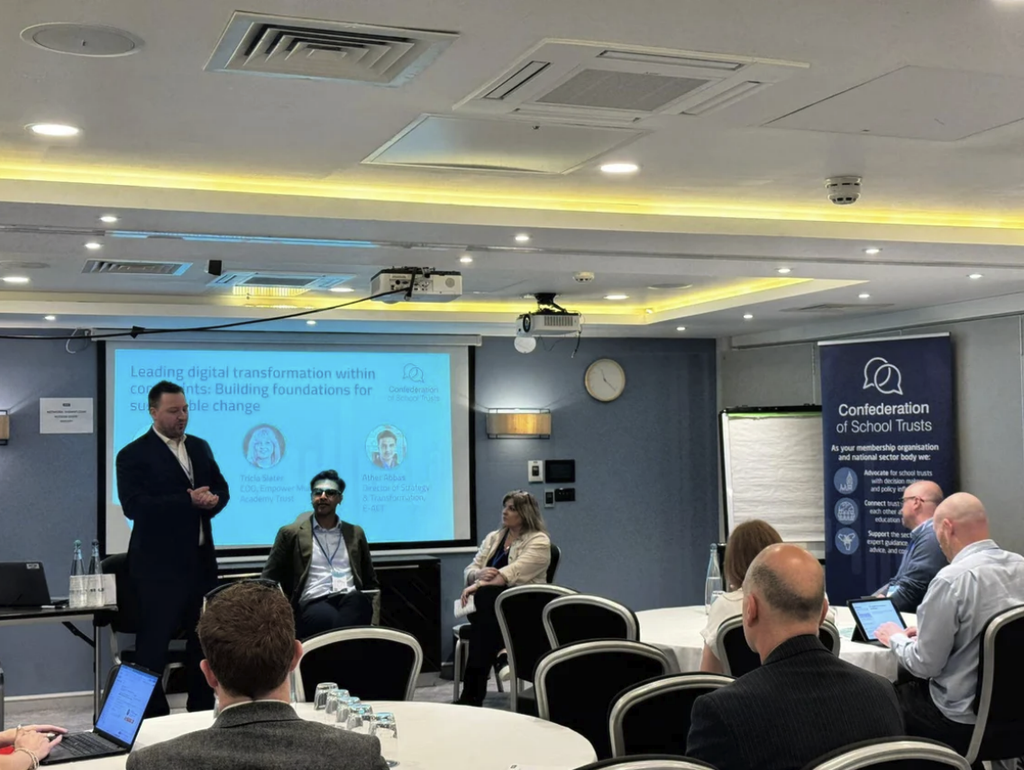
At the recent CST Data and Digital Transformation Conference, I had the privilege of chairing a discussion with Ather Abbas, Director of Strategy and Transformation at E-ACT, and Tricia Slater, COO at Empower Multi-Academy Trust, exploring a challenge that will be familiar to almost every trust leader: how do we deliver meaningful, sustainable transformation when ambition exceeds the capacity and funding available to us?
A key takeaway for me was that, despite E-ACT and Empower operating at very different scales, many of the fundamentals of successful transformation were remarkably consistent.
The discussion reinforced something I have seen repeatedly through our work with trusts at TransforMATive: transformation rarely fails because organisations lack ambition or ideas. The greater challenge is creating the organisational conditions that allow those ambitions to become reality.
Transformation has to start with people
One of the strongest messages from Ather’s contribution was that strategic transformation cannot simply become another technology programme.
E-ACT describes transformation as cross-functional, distinguishes it from business as usual, and places the creation of the right conditions for innovation at its heart. Perhaps most significantly, its thinking follows the sequence human behaviour > digital > data > AI, alongside an emphasis on collective intelligence and people.
That ordering matters.
It is tempting, particularly as AI develops at such pace, to begin conversations with platforms, tools and emerging technologies. But organisations do not transform because they have purchased better technology. They transform because people change how they work, collaborate, make decisions and solve problems.
Technology can enable that change. It cannot substitute for it.
For leaders, this means creating space for staff to understand why something is changing, contribute to how it develops and build the confidence required to adopt new practices.
Capacity is a strategic consideration, not an implementation problem
Tricia’s reflections from Empower brought this issue into particularly sharp focus.
As a smaller trust, Empower has had to make deliberate decisions about where to focus its resources. Its digital strategy runs from 2025 to 2030 and considers infrastructure, data, cyber security and innovation as part of a coherent approach rather than a series of isolated technology projects.
But having a strategy is only one part of the equation.
Empower explicitly recognises that limited organisational capacity requires initiatives to be prioritised and carefully phased, allowing progress without overextending the organisation.
This was perhaps my biggest reflection from the session.
We often talk about roadmaps in terms of what will happen and when. But a credible roadmap also needs to answer:
Who is going to deliver this, what capacity will they require, and what are we prepared to stop, delay or sequence differently to make it achievable?
Adding another programme to an already overloaded organisation isn’t transformation. In many cases, it simply creates another layer of pressure.
Capacity therefore needs to become part of the strategic conversation from the beginning rather than something we discover halfway through implementation.
Prioritisation doesn’t mean lowering ambition
One of the most useful examples from Empower was how it has approached investment.
The trust pooled Devolved Formula Capital funding to enable collective investment across its schools, making better use of the resources available to it. It also chose to prioritise high-quality devices for teachers before progressing further with student-facing technology.
There is an important principle here.
Transformation doesn’t always require doing more. Often it requires being clearer about what needs to happen first.
Getting the foundations right may feel less exciting than introducing the newest platform or innovation, but infrastructure, security, devices, skills, governance and data capability determine whether the next stage of transformation will succeed.
Good sequencing creates momentum.
Build change with the organisation, not to the organisation
Empower’s approach to digital champions was another example that resonated with me. Rather than selecting technology specialists, the trust identified strong teachers to lead peer-to-peer change, helping create credibility and adoption amongst colleagues.
That reflects a much broader lesson about organisational change.
Transformation becomes sustainable when capability spreads beyond the central team responsible for initiating it.
Digital transformation therefore shouldn’t create greater dependency on a small number of specialists. Done well, it should increase the confidence and capability of the wider organisation.
Empower similarly identifies active staff involvement, confidence-building and collaborative changes in practice as essential to cultural change.
That feels particularly important as trusts consider AI. The organisations that benefit most are unlikely to be those that simply provide access to the greatest number of AI tools. They will be those that develop the judgement, confidence and shared understanding required to use them effectively.
Governance has to connect ambition with reality
The final theme running through our discussion was governance.
Empower positions governance as central to oversight, accountability and ensuring that digital strategy remains aligned with wider organisational priorities.
For me, good governance should continually test the relationship between ambition, investment, capacity and impact.
Are we still solving the right problem?
Do we have sufficient capacity to deliver the next phase?
What evidence tells us the change is having the intended effect?
What have we learned that should influence the roadmap?
And, importantly, should something that appeared important twelve months ago still be a priority today?
A roadmap should provide direction without becoming a constraint. Sustainable transformation needs enough governance to maintain purpose and accountability, while retaining enough flexibility to respond to what the organisation learns along the way.
A reflection for autumn planning
The session reinforced that sustainable transformation is rarely about finding a single breakthrough technology or launching a huge programme of change.
It is about making deliberate choices.
Prioritising investment. Building strong foundations. Sequencing implementation. Creating organisational capacity. Engaging people. Developing capability. And ensuring governance continually connects activity back to organisational purpose.
Empower describes the challenge as balancing immediate operational requirements while building the foundations for scalable, pedagogy-first transformation. That balance is something every trust, regardless of size, has to navigate.
As leadership teams move into autumn planning, my reflection from the conversation is therefore a simple one:
A credible roadmap needs to explain not only what will change, but how the organisation will have the capacity to deliver it.
Because sustainable transformation isn’t measured by how much change we start.
It is measured by how much meaningful change we are actually able to embed.