
Leadership
By Jonny Wathen, CEO, TransforMATive
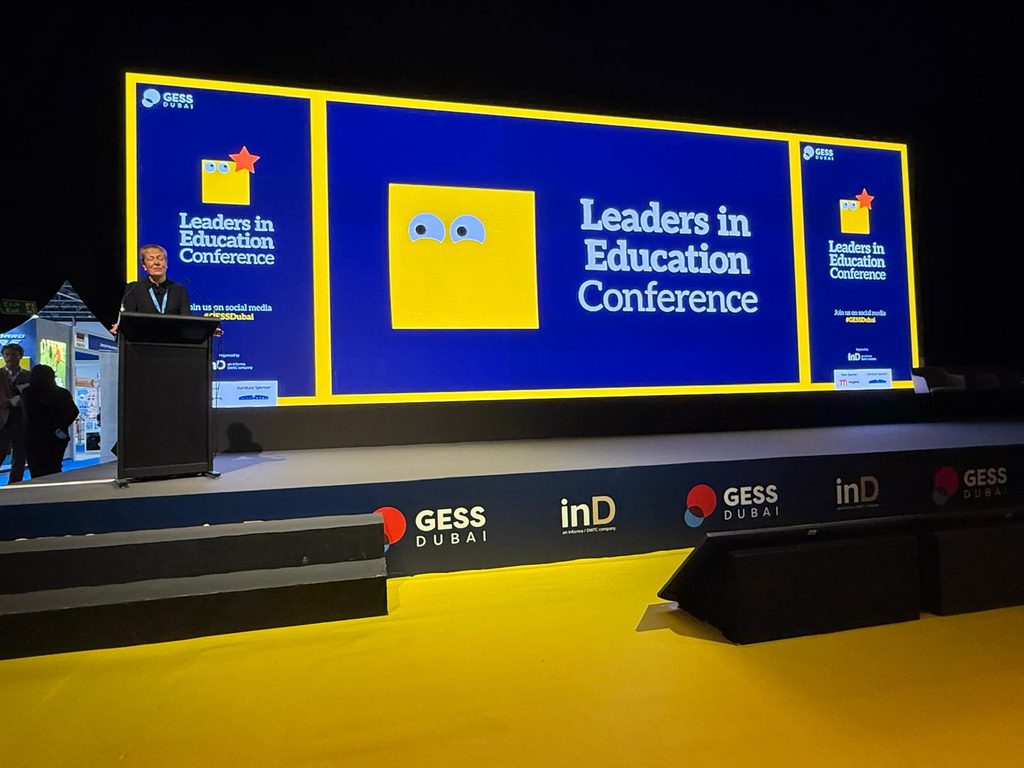
One phrase from a recent keynote by Pam Mundy at GESS Dubai has stayed with me:
“We live in exciting times.”
It is easy to describe the current period in education as uncertain, challenging or disruptive. All of those things are true. But they are not the whole story.
Across education, we are also witnessing extraordinary levels of innovation, investment, technological development and international collaboration. New ideas are travelling between systems more quickly than ever before. Artificial intelligence is challenging assumptions about teaching, learning, knowledge and expertise. Leaders are connecting across borders to compare approaches and question practices that may previously have gone unchallenged.
For me, that makes this an incredibly exciting time to be involved in education.
But technological progress alone will not determine whether this period ultimately improves education.
Leadership will.
Education is reaching a tipping point
There is a sense that education is approaching a significant inflection point.
Some of that is driven by technology, particularly artificial intelligence. Some is economic. Some reflects changing expectations from children, families, employers and governments. And some comes from our increasing ability to look beyond our own systems and learn from others.
What particularly resonated with me, while spending time in Dubai was the scale of ambition.
Dubai has developed into an important international meeting point for education. Leaders, schools, governments, investors, technology companies and researchers are arriving from different parts of the world, each bringing different experiences and perspectives.
That creates an opportunity that goes far beyond simply showcasing new products or technology.
It allows us to ask better questions.
Why do we organise education in the way that we do?
Which assumptions are genuinely evidence-based and which are simply inherited?
What can England learn from the UAE, Sweden, the United States or other systems?
And perhaps equally importantly, what should we choose not to replicate?
International collaboration is at its most valuable when it creates curiosity rather than conformity.
Technology gives us answers. Leadership still requires judgement.
Artificial intelligence is perhaps the most obvious example of the change taking place around us.
Access to information is no longer the constraint it once was.
Children, parents, teachers and leaders can increasingly access sophisticated explanations, recommendations and analysis instantly.
But information is not expertise.
And an answer is not necessarily the right answer.
That distinction is increasingly important.
AI can help us analyse information, generate possibilities, automate processes and challenge our thinking. In education, its potential is significant.
But it does not remove the need for professional judgement.
If anything, it increases it.
As the volume of information available to us grows, our ability to evaluate that information, understand context, recognise bias and make responsible decisions becomes increasingly important.
Perhaps we therefore need to think not only about artificial intelligence, but also about what we might call alternative intelligence.
Experience.
Wisdom.
Professional expertise.
Empathy.
Context.
Human relationships.
Moral judgement.
These are not things we should position in opposition to technology. The most powerful future is likely to emerge when human and artificial intelligence complement one another.
The challenge for education leaders is designing organisations where that happens intentionally.
Leadership itself is changing
One of the most interesting ideas raised was the concept of extreme leadership.
I found the idea particularly compelling because the expectations placed upon education leaders are changing rapidly.
Leadership development has traditionally prepared people to operate within relatively stable systems. We learn about strategy, finance, governance, people management, curriculum, operations and organisational improvement.
All of those capabilities remain essential.
But leaders are now also being asked to navigate technological disruption, cybersecurity, artificial intelligence, data ethics, workforce transformation, growing public expectations and global uncertainty.
Many of the decisions we face have no established precedent.
There is no handbook for every situation.
That means leadership increasingly requires the confidence to operate where the answer is not immediately obvious.
It requires curiosity.
It requires humility.
It requires conviction.
And sometimes it requires the courage to make a decision before perfect information is available.
The strongest leaders will not necessarily be those who claim to have all the answers. They may instead be those who create organisations capable of continually asking better questions.
Authenticity matters more as complexity increases
In periods of rapid change, values become increasingly important.
When there are dozens of possible directions an organisation could take, leaders need something against which those choices can be tested.
For me, some of the most important leadership questions are often the simplest:
Does this genuinely improve education?
Does this improve the experience or outcomes of children and young people?
Does this align with our values?
Would we be comfortable explaining this decision publicly?
Technology can make organisations faster.
Data can make organisations better informed.
AI can make organisations more productive.
But none of those things determine what an organisation should value.
That remains a leadership responsibility.
Authenticity and integrity therefore become increasingly important. Leaders will sometimes need to challenge fashionable ideas, resist pressure or acknowledge uncertainty.
There will be occasions when the most responsible decision is to move quickly.
There will also be occasions when leadership means saying: not yet.
Purpose and commercial sustainability can coexist
Another theme that deserves greater discussion is the relationship between social impact and commercial success.
Within education, we can sometimes be uncomfortable talking about profit, investment or commercial models.
That caution is understandable. Education exists to serve children and communities, not markets.
But commercial/financial sustainability and social purpose do not have to be opposing ideas.
The best organisations should be capable of delivering meaningful social impact while also operating sustainably.
Innovation requires investment.
High-quality people require investment.
Research, product development, infrastructure and support all require investment.
The question should therefore not simply be whether an organisation generates profit.
More important questions are how that value is created, where it is reinvested, whether outcomes genuinely improve and whether the relationship between provider and education institution remains ethical and transparent.
For suppliers working with education, commercial success should be a consequence of creating genuine value rather than the objective around which everything else revolves.
That balance is important to maintain.
What might this mean for leaders in England?
England has an education system with considerable strengths, but we can sometimes become overly focused on the constraints within our own environment.
Policy.
Funding.
Accountability.
Inspection.
Workforce pressures.
All are significant.
But international conversations remind us that the structures we operate within are not inevitable.
Other countries make different choices.
They organise schools differently.
They approach technology differently.
They develop teachers differently.
They fund innovation differently.
They define success differently.
For leaders in England, there is enormous value in occasionally stepping outside the system intellectually and asking what education might look like if we were designing parts of it today.
That does not mean importing another country’s model wholesale.
Context matters enormously.
But it does mean remaining curious enough to challenge assumptions.
And what might this mean globally?
The same principle works in the opposite direction.
There is no single global model of excellent education.
Systems reflect their history, culture, economy, geography and social expectations.
The opportunity therefore lies in collaboration without assuming uniformity.
International education networks should not simply become mechanisms for exporting practices from one country to another.
They should become places where leaders compare perspectives.
Where assumptions are challenged.
Where evidence is examined.
And where ideas are adapted intelligently to local context.
We should learn from one another without losing sight of the communities we actually serve.
Eight considerations for education leaders
As I reflected on the conversation, I found myself returning to eight questions that feel increasingly important for leaders, whether they are working in England or elsewhere in the world:
- Are we preparing our organisations for technological change, or simply reacting to it?
- Do our people understand the difference between access to information and genuine expertise?
- Are we developing human judgement alongside artificial intelligence?
- Which assumptions within our education system should we be willing to challenge?
- Are our commercial and technology partnerships genuinely creating educational value?
- Do our leaders have permission to experiment, question and occasionally get things wrong?
- Are we actively learning from education systems beyond our own borders?
- When difficult decisions arise, are children and young people still at the centre of them?
That final question is perhaps the most important.
Children must remain the constant
Technology will change.
Governments will change.
Policies will change.
Organisational structures will change.
The tools available to educators will undoubtedly become more sophisticated.
But the fundamental responsibility of education leaders remains remarkably consistent.
We are here to create better opportunities for children and young people.
That purpose provides an important anchor when everything else feels as though it is moving.
The future of education will not be determined simply by which organisations adopt AI fastest, deploy the most technology or generate the most data.
It will be shaped by the quality of the decisions leaders make with those capabilities.
By their judgement.
By their integrity.
By their willingness to collaborate.
And by their determination to advocate for children.
That is why I left the conversation feeling optimistic.
We undoubtedly live in interesting times.
But perhaps the better description is the one I heard in Dubai:
We live in exciting times.
Our responsibility as leaders is to make sure we do something worthwhile with them.